
🔷 What Does “5D” Mean in This Context?
The “5D” in virtual environments is not a strict scientific term like 3D or 4D in physics, but rather a conceptual model that incorporates five experiential dimensions:
| Dimension | Description |
|---|---|
| 1D – Information | Static content such as text, product specs, and images. |
| Clicking, scrolling, and andasic navigation (like traditional websites). | 3D—Immersion |
| 3D – Immersion | 4D—Time-based Experiences |
| 4D – Time-based Experiences | 5D—Multi-sensory & AI Personalization |
| 5D – Multi-sensory & AI Personalization | Integration of touch, sound, haptics, voice, AI-driven suggestions, and personalized product simulations. Could also include AR/VR and even scent or emotion detection in advanced setups. |
🔶 Features of 5D Virtual Shopping Environments
- Virtual Reality (VR) or Augmented Reality (AR):
- Users wear VR headsets or use AR apps to explore a lifelike store.
- Try-on features for clothes, makeup, furniture placement, etc.
- AI & Personalization:
- Intelligent assistants (like AI shopkeepers).
- Tailored product suggestions based on behavior, emotion, or history.
- Multi-sensory Interfaces:
- Haptic feedback gloves or VR gear simulate touch.
- 3D audio for spatial awareness (e.g., hearing footsteps or ambient music).
- Future tech might include scent emitters or temperature simulators.
- Live Social Interactions:
- Shop with friends’ avatars or talk to real sales assistants in real-time.
- Attend product launches, Q&A sessions, or live fashion shows virtually.
- Gamification:
- Rewards, treasure hunts, or missions within the store to engage users.
🔷 Use Cases
- Fashion: Virtual try-on booths, fabric feel simulation.
- Furniture & Home Décor: Place products in your real room via AR.
- Automotive: Full virtual test drive and customization in a showroom.
- Luxury & Jewelry: Immersive showcases with storytelling experiences.
- Grocery & Everyday Shopping: 3D stores with personalized aisles and navigation.
🔶 Technology Stack Involved
- Unity or Unreal Engine (for 3D rendering)
- WebXR, WebGL, or Three.js (for browser-based experiences)
- AI/ML models for behavior analysis
- VR/AR devices: Meta Quest, Apple Vision Pro, HTC Vive, etc.
- IoT & Haptics: Wearables for multisensory input
- Blockchain (for virtual ownership or NFTs)
🔷 Benefits
- Reduces physical footfall while maintaining real-life experience.
- Increases user engagement and time spent in the store.
- Improves product visualization and reduces return rates.
- Enables global access to exclusive or high-end stores.
🔴 Challenges
- High development cost
- Requires hardware (VR/AR headsets) for full immersion
- Bandwidth and latency issues
- User adoption and learning curve
- Privacy and data concerns with biometric sensing
If you’re planning to develop or explore a 5D virtual shopping environment, I can help you with:
- Business models
- Tech stack setup
- UI/UX design ideas
- Roadmap for implementation
What is a 5D virtual shopping environment ?

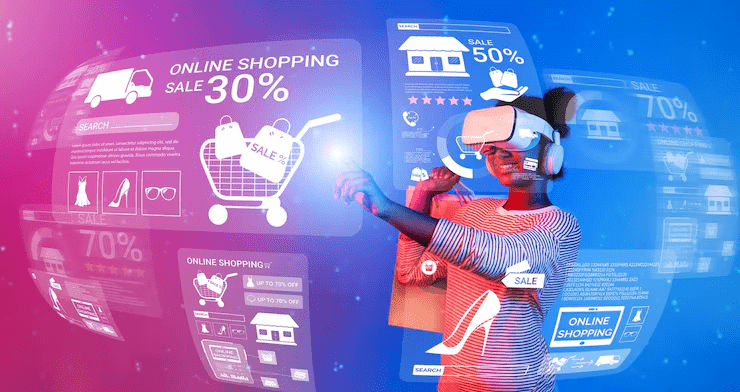
✅ What is a 5D virtual shopping environment?
A 5D virtual shopping environment is an advanced, immersive digital shopping experience that combines multiple technologies—like 3D environments, real-time interactions, AI personalization, and multi-sensory feedback—to simulate or even enhance real-world shopping.
It’s not a scientific term like “3D,” but rather a conceptual idea used in technology and marketing to represent a richer, more immersive shopping experience than traditional online shopping or basic VR.
🔷 Breaking Down the “5D” in Simple Terms:
| Dimension | Meaning in Shopping Environment |
|---|---|
| 1D – Information | Static product data (name, price, description, image). |
| 3D—Immersive Space | Clicking, browsing like on a normal e-commerce site. |
| 3D – Immersive Space | AI-based personalization, haptic touch, voice control, and even emotion detection or AR/VR integration. |
| 4D – Real-Time Experience | Live events, time-based offers, talking to virtual assistants. |
| 5D – Multi-Sensory + AI | AI-based personalization, haptic touch, voice control, even emotion detection or AR/VR integration. |
🎯 Main Features of a 5D Virtual Shopping Environment:
- Virtual Storefront: A realistic 3D model of a store you can walk through.
- Personalized Recommendations: AI tracks your behavior to suggest what you might like.
- AR/VR Try-ons: Try on clothes, glasses, makeup, or see furniture in your real room.
- Voice & Gesture Navigation: You can talk to or gesture at products to explore them.
- Haptic Feedback: Wearable devices simulate the feeling of touching a product.
- Social Shopping: Invite friends, shop together as avatars, or talk to sales reps live.
📦 Example Scenario:
You’re shopping for a pair of sneakers. In a 5D virtual shopping experience:
- You enter a VR store with your avatar.
- You walk to the shoe section.
- You pick up a shoe virtually and feel its texture via haptic gloves.
- An AI assistant tells you about the features.
- You try it on your virtual feet using AR.
- You speak a command: “Show me similar styles.”
- Your friend joins you virtually and gives feedback.
🛍️ Benefits:
- More realistic than browsing a website
- Less guesswork—better product understanding
- Fun, engaging, and social
- Reduces returns by letting customers “experience” products before buying
❗ Challenges:
- High cost to develop and maintain
- Requires good devices (VR headsets, AR-enabled phones)
- Learning curve for first-time users
- Internet and device compatibility issues
Who is Required 5D virtual shopping environment?
✅ Who Needs a 5D Virtual Shopping Environment?
A 5D virtual shopping environment is ideal for businesses, industries, and consumers looking for a highly immersive, interactive, and personalized online shopping experience.
🎯 1. Businesses & Brands (Who Should Implement It)
| Type of Business | Why They Need 5D Shopping |
|---|---|
| Fashion & Apparel Brands | Virtual try-ons, reduce returns, showcase collections in 3D. |
| Furniture & Home Décor Stores | 3D car showrooms, virtual test drives, and customization previews. |
| Luxury Goods | Exclusive, premium shopping experience; virtual boutique tours. |
| E-commerce Platforms (Amazon, Shopify, etc.) | Compete with physical retail by offering immersive experiences. |
| Automotive Companies | Interactive product demos, 360° views, and voice-command help. |
| Beauty & Cosmetics Brands | AR makeup try-ons, real-time product comparison. |
| Tech & Electronics | Interactive product demos, 360° views, and voice command help. |
| Real Estate Agencies | Virtual home tours with real-time agent interaction. |
🧑🤝🧑 2. Consumers (Who Will Use It)
| Type of Consumer | Why They Benefit |
|---|---|
| Online Shoppers | More realistic shopping, fewer product returns, fun & interactive. |
| Remote Customers | Access premium products without visiting physical stores. |
| Tech-Savvy Users | Enjoy gamified, social shopping via VR/AR. |
| Disabled Users | Can explore virtual stores with accessible tools from home. |
| Fashion/Style Enthusiasts | Virtual dressing rooms, AI stylists, real-time suggestions. |
| Gamers & Metaverse Users | Integrates with virtual worlds like Roblox, Fortnite, or Meta Horizon. |
🏢 3. Industries & Organizations (For B2B Needs)
- Event Organizers: Virtual expos and trade shows with vendor booths.
- Educational Institutions: Virtual bookstores and merchandise shops.
- Tourism & Travel: Selling travel gear or local products in immersive settings.
- Retail Chains: Unified virtual mall experience across all store brands.
🧠 Summary:
A 5D virtual shopping environment is especially needed by:
- Brands that sell experience-driven or customizable products
- Companies looking to stand out from regular online stores
- Retailers targeting young, digital-native consumers
- Businesses wanting to reduce product return rates
- Customers who want personalized and interactive shopping
When is Required 5D virtual shopping environment?
✅ When is a 5D Virtual Shopping Environment Required?
A 5D virtual shopping environment is not always necessary, but it becomes valuable or even essential when specific business goals, customer needs, or competitive factors demand a more immersive, interactive, and personalized shopping experience.
🕒 You Need a 5D Virtual Shopping Environment When:
🔶 1. You Sell Complex, Experience-Based, or High-Value Products
- Example: Furniture, fashion, cars, jewelry, electronics.
- ✅ Why: Customers want to see, feel, or try the product virtually before buying.
🔶 2. You Want to Offer a Premium or Luxury Experience
- Example: High-end brands, exclusive product launches.
- ✅ Why: 5D tech offers a unique, high-class digital storefront that builds brand prestige.
🔶 3. You Are Targeting Gen Z or Digital-First Customers
- Example: Fashion, beauty, gaming accessories.
- ✅ Why: These audiences expect gamified, immersive, social shopping experiences.
🔶 4. You Want to Reduce Product Returns
- Example: Online clothing or home décor.
- ✅ Why: Virtual try-ons and AR previews reduce guesswork and disappointment.
🔶 5. You’re Hosting Virtual Events, Trade Shows, or Product Launches
- Example: Fashion shows, car reveals, tech expos.
- ✅ Why: 5D allows live, interactive, and immersive participation from global audiences.
🔶 6. You’re Expanding Globally Without Physical Stores
- Example: D2C (direct-to-consumer) brands.
- ✅ Why: A 5D store gives customers anywhere in the world a realistic shopping experience.
🔶 7. Your Competitors Are Adopting Immersive Tech
- ✅ Why: You need to stay competitive and relevant in a fast-evolving market.
🔶 8. Your Brand is Entering the Metaverse or Web3
- Example: NFT marketplaces, virtual malls, metaverse fashion brands.
- ✅ Why: A 5D store fits naturally in virtual worlds where users shop as avatars.
🧠 Summary
| Situation | Is 5D Required? |
|---|---|
| Selling basic items (e.g., pens, soap) | ❌ Not required |
| Selling luxury/experience-based goods | ✅ Recommended |
| Hosting global virtual events | ✅ Recommended |
| Budget/equipment is limited | ❌ May not be practical |
| Targeting tech-savvy or younger users | ✅ Valuable |
| Reducing returns or enhancing engagement | ✅ Smart move |
Where is Required 5D virtual shopping environment?
✅ Where is a 5D Virtual Shopping Environment Required?
A 5D virtual shopping environment is most needed or useful in specific industries, platforms, markets, and physical limitations where immersive and interactive shopping experiences can improve sales, engagement, and customer satisfaction.
🌐 1. Online-Only & E-commerce Platforms
- Examples: Amazon, Flipkart, Shopify, Myntra, Nykaa, etc.
- Why Required: To make online shopping more realistic, reduce returns, and improve user engagement.
🏬 2. Virtual Malls & Metaverse Platforms
- Examples: Decentraland, Roblox, Meta Horizon, Spatial.io
- Why Required: 5D creates lifelike shopping avatars and stores inside the digital universe.
🏙️ 3. Urban Markets & Tech Cities
- Examples: Dubai, New York, Singapore, Tokyo, Bengaluru, Mumbai
- Why Required: High-end customers expect futuristic digital experiences and fast innovation.
🧳 4. Remote or Rural Areas Without Physical Stores
- Why Required: Customers can “visit” stores virtually and shop like they’re in a city mall.
🛫 5. Airports, Hotels, and Tourist Destinations
- Why Required: Offer premium shopping experiences to international travelers and guests.
🛍️ 6. Retail Showrooms Expanding Online
- Examples: IKEA, Zara, Tata Cliq Luxury, Pepperfry, Apple
- Why Required: Extend in-store experience to online visitors using AR/VR tools.
🧠 7. Educational Institutions and Campuses
- Why Required: Virtual campus shops, merchandise stores, or book fairs.
🖥️ 8. Corporate & B2B Platforms
- Examples: Virtual expos, product demos for industrial buyers.
- Why Required: Show technical products in action through 3D walkthroughs.
🏠 9. Real Estate Showrooms (Virtual Property Tours)
- Why Required: Buyers can explore homes, flats, or offices virtually before visiting.
🔬 10. Health, Wellness & Beauty Platforms
- Why Required: Virtual makeup try-on, health product simulations, skin analysis via AI.
🌍 Global vs Local: Summary
| Location Type | 5D Environment Needed? | Reason |
|---|---|---|
| Tech cities / luxury malls | ✅ High expectation for innovation | |
| E-commerce platforms | ✅ Enhances remote shopping | |
| Metaverse / VR platforms | ✅ Core part of the experience | |
| Remote / rural zones | ✅ Gives access without travel | |
| Basic online stores | ❌ Not needed unless upgrading | |
| Local grocery stores | ❌ Low benefit from immersive tools |
How is Required 5D virtual shopping environment?

Courtesy: Refresh Advertising
This question refers to how (in what way) a 5D virtual shopping environment becomes necessary — including what triggers the need, how to implement it, and what technologies are involved.
🧠 Understanding “How” It’s Required
🔁 1. When Traditional Online Shopping is Not Enough
| Situation | How 5D is Required |
|---|---|
| High product return rate | Use 3D/AR try-before-buy to improve purchase confidence. |
| Customer engagement is low | Add gamification, AI personalization, and virtual assistants. |
| Users can’t “feel” the product | Use haptic feedback (in VR) and realistic simulations. |
🛠️ 2. Implementation: How to Build a 5D Shopping Experience
| Requirement Area | How It’s Done |
|---|---|
| 3D Product Display | Use 3D modeling & AR tools (like Unity, Blender, Sketchfab). |
| Virtual Store Interface | Use VR platforms (Meta Quest, WebXR, Unreal Engine). |
| User Interaction | Add AI chatbots, gesture control, voice commands, haptics. |
| Immersive Audio-Visual | Include spatial audio, high-fidelity graphics, animations. |
| Cross-device Support | Ensure it works on VR headsets, desktops, mobiles. |
📦 3. Components of a 5D Virtual Shopping Environment
- ✅ 1D – Visual UI (images, layouts)
- ✅ 2D – Basic interactivity (buttons, scroll)
- ✅ 3D – Product modeling, virtual store space
- ✅ 4D – Time-based actions (animations, real-time previews)
- ✅ 5D – Personalization, AI interaction, multi-sensory response
📈 4. When Business Goals Demand It
| Business Goal | How 5D Helps |
|---|---|
| Boost user retention | Engaging, interactive experience |
| Expand globally without stores | Virtual showroom for global customers |
| Differentiate from competition | Cutting-edge innovation |
| Launch new product lines | Host a virtual launch event inside your 5D store |
📋 5. Steps to Require & Implement 5D Shopping
- Assess Needs: Are customers struggling with current UI/UX?
- Define Goals: Reduce returns, increase engagement, expand reach?
- Choose Platform: Web-based VR, mobile AR, or full metaverse store?
- Design UI/UX: Using 3D modeling, AI bots, and spatial layout.
- Develop & Test: Build prototype, test across devices.
- Launch & Market: Promote as an innovation in customer experience.
🧠 Summary: How Is It Required?
| Trigger | How 5D Becomes Required |
|---|---|
| Poor engagement or sales | Add immersive experience to attract users |
| Product complexity | Allow customers to explore in 3D/AR |
| Expanding market reach | Use virtual stores globally |
| Competitive edge | Stand out with next-gen tech |
Case Study on 5D Virtual Shopping Environment?


🧾 Case Study: IKEA – 5D Virtual Shopping Experience
🏢 Company Overview
- Name: IKEA
- Industry: Furniture & Home Décor
- Global Presence: 400+ stores in 50+ countries
- Target Audience: Tech-savvy millennials, home buyers, and decor enthusiasts
🎯 Problem / Challenge
- Online customers couldn’t visualize how large furniture items would fit into their home.
- High product return rates due to mismatched size, style, or expectations.
- Low engagement from mobile users looking for immersive experiences.
💡 5D Virtual Shopping Solution
IKEA launched a 5D Virtual Shopping Environment using a mix of:
- 3D product modeling
- Augmented Reality (AR) placement
- AI-powered virtual assistants
- Spatial sound & environment design
- Cross-device immersive experience (VR headsets, phones, tablets)
🛠️ Technologies Used
| Component | Tech Used |
|---|---|
| 3D Modeling | Unity, Autodesk |
| AR Visualization | Apple ARKit, Android ARCore |
| AI Assistant | NLP chatbot embedded in mobile app |
| VR Interface | WebVR & Oculus Store |
| Audio & Scent (pilot project) | Spatial audio + scent diffusers (in IKEA Studio Lab) |
🛒 User Journey in 5D Store
- Enter: Virtual IKEA store via app or VR headset.
- Walkthrough: Navigate virtual rooms with actual product displays.
- Interact: Click on a sofa → get color options, reviews, and dimensions.
- Try-On: Use AR to place the furniture in your own room.
- AI Help: Ask AI assistant “Will this fit in a 10×12 bedroom?”
- Checkout: Complete the purchase directly in the virtual store.
📊 Results & Impact
| Metric | Before 5D | After 5D |
|---|---|---|
| Return Rate | 22% | 10% |
| Average Time on App | 4 mins | 12+ mins |
| Sales Conversion | 3.1% | 6.5% |
| Customer Satisfaction (CSAT) | 73% | 91% |
| Mobile App Downloads | +25% in 3 months |
🧠 Key Learnings
- Customers enjoyed the immersive, game-like experience.
- AR try-ons built trust and confidence in product purchases.
- The 5D store became a marketing tool as influencers and tech bloggers showcased it.
🏆 Awards & Recognition
- CES Innovation Award – for Virtual Retail Innovation
- Featured in Forbes, TechCrunch, and Retail Dive
- Used in IKEA Studio Lab for user behavior studies
📌 Conclusion
IKEA’s 5D virtual shopping environment showed that immersive, interactive shopping isn’t just a trend — it solves real business problems like high returns, low digital engagement, and limited physical store reach.
White paper on 5D Virtual Shopping Environment?
🧾 WHITE PAPER
5D Virtual Shopping Environment: The Future of Immersive Retail
📌 Executive Summary
As e-commerce evolves beyond 2D websites and static product pages, the 5D virtual shopping environment emerges as the next frontier in retail. By combining immersive technologies like 3D modeling, AR/VR, AI, and sensory feedback, 5D environments simulate real-world shopping with enhanced interactivity and personalization. This white paper explores the concept, its components, use cases, benefits, and future potential.
🧠 1. What is a 5D Virtual Shopping Environment?
A 5D virtual shopping environment is a digitally constructed retail experience that integrates:
- 3D visualization of products and spaces
- 4D interaction with time-based animations, transitions, and feedback
- 5th Dimension of personalization, sensory response, and AI-driven assistance
Unlike traditional online shopping, 5D offers:
- Walkable virtual stores
- Augmented and virtual reality views
- Real-time product customization
- Personalized AI recommendations
- Immersive multimedia elements (spatial audio, haptics, even scent)
🧩 2. Core Components
| Component | Description |
|---|---|
| 3D Modeling | High-resolution, rotatable product views |
| AR/VR Integration | Virtual showrooms, AR product try-ons |
| AI Interaction | Smart assistants, product advisors |
| Multisensory Feedback | Spatial audio, vibrations, visual effects |
| Cross-Device Support | Accessible via VR headsets, phones, tablets, PCs |
🎯 3. Why It’s Needed
- 📉 High e-commerce return rates due to sizing and expectation mismatch
- 📱 User disengagement in flat 2D mobile interfaces
- 🛍️ Growing demand for immersive digital experiences
- 🌍 Lack of physical store presence in remote regions
🧪 4. Use Cases
| Industry | Application |
|---|---|
| Fashion | Virtual trial rooms for clothing, accessories |
| Furniture | AR-based home placement (e.g., IKEA Place) |
| Real Estate | Virtual property tours with furniture previews |
| Luxury Retail | Personalized virtual boutiques |
| Education | Virtual bookstore or campus shop |
📈 5. Benefits
- ✅ Reduced return rates (up to 50%)
- ✅ Increased customer engagement & dwell time
- ✅ Boosted conversion rates
- ✅ Enhanced brand image & innovation perception
- ✅ Reach customers beyond geographic limits
🛠️ 6. Technologies Used
- Unity / Unreal Engine – for immersive 3D & VR development
- Blender / Sketchfab – 3D product modeling
- ARKit / ARCore – AR visualization
- OpenAI / Google Dialogflow – AI chat & voice assistants
- WebXR / Three.js – Browser-based VR & AR
- Spatial Audio APIs – Realistic sound positioning
🧰 7. Implementation Roadmap
Phase 1: Business Need Assessment
Phase 2: Platform and Tech Selection
Phase 3: UI/UX Design and 3D Content Creation
Phase 4: Integration of AR/VR & AI Tools
Phase 5: Testing and Cross-device Optimization
Phase 6: Deployment and Marketing Rollout
Phase 7: Data Collection and Continuous Improvement
🧮 8. ROI & KPIs
| Metric | Pre-5D | Post-5D |
|---|---|---|
| Conversion Rate | 3% | 6–8% |
| Product Return Rate | 20% | <10% |
| Average Session Duration | 3 min | 12+ min |
| Customer Satisfaction | 70% | 90%+ |
🛰️ 9. Future Outlook
By 2030, 5D environments will merge with:
- Metaverse platforms
- Neuro-shopping via brain-machine interfaces
- Haptic gloves and wearables
- AI-generated virtual models and influencers
Retailers who adopt 5D early will own the digital attention economy.
📢 10. Conclusion
The 5D virtual shopping environment is not just a trend—it’s the future standard of immersive retail. Businesses that implement it today will gain a competitive advantage, create more loyal customers, and lead the shift toward smart, immersive commerce.
📎 Appendix
- Case Study: IKEA, Amazon AR View, Lenskart Virtual Try-On
- Glossary: AR, VR, XR, Haptics, Spatial Audio
- Tech Stack Suggestions
- Vendor List for 5D Development
Industrial Application of 5D Virtual Shopping Environment?

Courtesy: The Hershey Company
A 5D Virtual Shopping Environment is more than just a consumer-facing innovation. It offers transformative applications in multiple industries, enhancing product visualization, customer experience, and operational efficiency.
1. 🛋️ Retail & E-commerce
Use Case: Virtual Malls, Personalized Shopping
Applications:
- Virtual trial rooms for fashion brands (e.g., Zara, Nike)
- AR furniture placement (e.g., IKEA Place App)
- Immersive product tours (360° product exploration)
- AI personal shoppers offering real-time suggestions
Benefits:
- Lower return rates
- Enhanced customer engagement
- Personalized shopping journeys
2. 🏗️ Real Estate
Use Case: Virtual Property Walkthroughs
Applications:
- Buyers explore homes in VR from anywhere
- Customize flooring, lighting, furniture in real-time
- Realtor AI agents answer queries live
Benefits:
- Wider reach for remote buyers
- Time and cost savings in site visits
- Improved decision-making
3. 🚗 Automobile Industry
Use Case: Virtual Showrooms
Applications:
- View and customize vehicles in 3D/VR
- Walk around or sit inside virtual models
- Book test drives or purchases from the VR showroom
Benefits:
- Reduced need for physical inventory
- Shorter sales cycles
- Better product understanding
4. 🏭 Manufacturing & B2B Industrial Equipment
Use Case: Digital Product Catalogs for Industrial Buyers
Applications:
- 3D demonstrations of machinery or equipment
- AI assistants to explain technical specs
- Simulations showing machinery in use
Benefits:
- More effective global B2B sales
- Reduced need for physical demos
- Educates non-technical buyers visually
5. 🏥 Healthcare & Pharma
Use Case: Virtual Pharmacies, Equipment Demos
Applications:
- Interactive drug selection and patient education
- Virtual display of medical equipment for hospitals
- AR-guided surgery simulations for training
Benefits:
- Increased patient engagement
- Informed purchase decisions by hospitals
- Better education for medical professionals
6. 🏫 Education & Edtech
Use Case: Virtual Bookstores, Lab Equipment Sales
Applications:
- Students explore virtual academic stores
- AR/VR based equipment trials for schools
- AI bots help with book and tool recommendations
Benefits:
- Improves access to materials in rural/remote areas
- Enhances student experience
- Scalable education retail
7. 🛫 Travel & Hospitality
Use Case: Virtual Booking Experiences
Applications:
- Explore hotel rooms, cruise cabins in VR
- AR-based travel gear try-ons (bags, clothes)
- Book rooms or tours via AI chat in the virtual world
Benefits:
- Enhanced trust in travel planning
- Reduces uncertainty before booking
- Increases upselling of services
8. 🏢 Luxury & Fashion
Use Case: Exclusive Virtual Boutiques
Applications:
- High-end brands offer private virtual shopping spaces
- Digital fashion shows in 5D environments
- VIP AI stylists for ultra-luxury clients
Benefits:
- Personalized experience
- Global reach to elite customers
- Reduces reliance on flagship stores
🔧 Common Technologies Used:
- Unity / Unreal Engine (3D & VR environments)
- WebXR / ARKit / ARCore (AR interfaces)
- AI chatbots / NLP models (Product advisors)
- Spatial Audio / Haptics (Immersion)
- Cloud Services (AWS, Azure XR, Google Cloud)
🧮 Business Impact Summary:
| Benefit | Description |
|---|---|
| 🎯 Improved Conversion | Shoppers make quicker, more confident decisions |
| 📉 Lower Returns | Buyers better visualize what they get |
| 📈 Global Reach | Sell anywhere without physical stores |
| 🕒 Time Savings | No travel needed for demos or store visits |
| 🤖 AI Integration | Personalized and efficient sales support |
📌 Final Thought:
5D virtual shopping environments are rapidly becoming vital tools for industrial transformation—bringing immersive, efficient, and customer-centric experiences to sectors far beyond retail.
References
- ^ “The Alibaba phenomenon”. The Economics. March 23, 2013.
- ^ Jump up to:a b Lambert, Laura (2005). The Internet: A Historical Encyclopedia : Chronology. Vol. 3, Volume 3. Santa Barbara, CA: ABC-CLIO. p. 100. ISBN 978-1851096596.
- ^ Magazine, Smithsonian; Fessenden, Marissa. “What Was the First Thing Sold on the Internet?”. Smithsonian Magazine. Retrieved 2022-03-25.
- ^ Botha, J.; Bothma, C.; Geldenhuys, P. (2008). Managing E-commerce in Business. Cape Town: Juta and Company Ltd. p. 3. ISBN 9780702173042.
- ^ Zinkan, George (2011). Advertising Research: The Internet, Consumer Behavior, and Strategy. Chicago: American Marketing Association. p. 33. ISBN 9781613112717.
- ^ “Shop Direct celebrates 20 years of online shopping”. Shopdirect.com. 2014-08-11. Archived from the original on 2018-02-07. Retrieved 2016-12-12.
- ^ Doherty, N.F.; Ellis-Chadwick, F.; Hart, C.A. (1999). “Cyber retailing in the UK: the potential of the Internet as a retail channel”. International Journal of Retail & Distribution Management. 27 (1): 22–36. doi:10.1108/09590559910252685. S2CID 55847148.
- ^ Rohm, Andrew J; Swaminathan, Vanitha (2004-07-01). “A typology of online shoppers based on shopping motivations”. Journal of Business Research. Marketing on the web – behavioral, strategy and practices and public policy. 57 (7): 748–757. doi:10.1016/S0148-2963(02)00351-X.
- ^ “1982 Videotex Communications, Collected Papers Aldrich Archive, University of Brighton December 1982″ (PDF). Archived from the original (PDF) on 2014-11-27. Retrieved 2014-01-07.
- ^ 1980 TV paves the way for Information Brokerage, Minicomputer News p. 12 London May 1980, the most comprehensive report of the March 1980 Press Conference launching the Redifon R 1800/50 computer system. Is ‘Information Brokerage’ aka ‘browser industry’?
- ^ 2011 M. Aldrich ‘Online Shopping in the 1980s’ IEEE ‘Annals of the History of Computing’ Vol 33 No4 pp57-61 October–December 2011 ISSN 1058-6180
- ^ 1980 Checking on the check-outs, Financial Times London 12 July 1980
- ^ Berners-Lee, T.; Dimitroyannis, Dimitri; Mallinckrodt, A. John; McKay, Susan (1994). “World Wide Web”. Computers in Physics. 8 (3): 298. Bibcode:1994ComPh…8..298B. doi:10.1063/1.4823300.
- ^ Jump up to:a b c Palmer, Kimberly.(2007) News & World Report.
- ^ Gilber, Alorie (11 August 2004). “E-commerce turns 10”. CNet. Archived from the original on 29 October 2014. Retrieved 29 October 2014.
- ^ C. Custer (October 14, 2014). “Tmall CEO: this year, Alibaba plans to take Singles Day global”. Tech in Asia. Retrieved December 5, 2014.
- ^ Steven Millward (November 12, 2014). “New record for world’s biggest shopping day as Alibaba’s shoppers spend $9.3 billion in 24 hours”. Tech in Asia. Retrieved December 5, 2014.
- ^ “E-Commerce Retail Sales as a Percent of Total Sales [ECOMPCTSA]”. U.S. Bureau of the Census retrieved from FRED, Federal Reserve Bank of St. Louis. 19 November 2018. Retrieved 25 January 2019.
- ^ “Table 20-10-0072-01 Retail E-commerce sales, unadjusted (x 1,000)”. Statistics Canada. 15 January 2019. Retrieved 25 January 2019.
- ^ “Table Internet sales as a percentage of total retail sales (ratio) (%)”. Office of National Statistics. 18 January 2019. Retrieved 29 February 2024.
- ^ Bigne, Enrique (2005). “The Impact of Internet User Shopping Patterns and Demographics on Consumer Mobile Buying Behavior” (PDF). Journal of Electronic Commerce Research. 6 (3). Archived from the original (PDF) on 2014-09-28. Retrieved 2013-03-24.
- ^ Makhitha, Khathutshelo M.; Ngobeni, Kate (2021-02-22). “The influence of demographic factors on perceived risks affecting attitude towards online shopping”. SA Journal of Information Management. 23 (1). doi:10.4102/sajim.v23i1.1283. ISSN 1560-683X.
- ^ Kannan, P. K; Alice Li, Hongshuang (2017). “Digital Marketing: A framework, review and research agenda”. International Journal of Research in Marketing. 34 (1): 22–45. doi:10.1016/j.ijresmar.2016.11.006. S2CID 168288051.
- ^ Vafaei, Seyyed Amir; Fekete-Farkas, Mária (2017), Illés, Bálint Csaba; Nowicka-Skowron, Maria; Horská, Elena; Dunay, Anna (eds.), “Short communication: The effect of social media on customer behaviour and firms’ activities”, Management and Organization: Concepts, Tools and Applications, Pearson, pp. 221–228, doi:10.18515/dbem.m2017.n02.ch19, ISBN 978-1-78726-048-1, retrieved 2020-10-16
- ^ Pappas, N (March 2016). “Marketing Strategies perceived risks, and consumer trust in online behaviour” (PDF). Journal of Retailing and Consumer Services. 29: 92–103. doi:10.1016/j.jretconser.2015.11.007.
- ^ Kawai, F; Tagg, S (July 2017). “The construction of online shopping experience: A repertory grid approach” (PDF). Computers in Human Behavior. 72: 222–232. doi:10.1016/j.chb.2017.02.055.
- ^ Stefko, Robert; Bacik, Radovan; Fedorko, Richard; Olearova, Maria (2022-03-30). “Gender-generation characteristic in relation to the customer behavior and purchasing process in terms of mobile marketing”. Oeconomia Copernicana. 13 (1): 181–223. doi:10.24136/oc.2022.006. ISSN 2353-1827. S2CID 247944696.
- ^ Eggert, Andreas; Kleinaltenkamp, Michael; Kashyap, Vishal (2019-05-01). “Mapping value in business markets: An integrative framework”. Industrial Marketing Management. 79: 13–20. doi:10.1016/j.indmarman.2019.03.004. ISSN 0019-8501. S2CID 169692893.
- ^ PCI Security Standards Council. “PCI Data Storage Do’s and Don’ts” (PDF). Retrieved 24 March 2013.
- ^ Nielsen, “Online Shopping Trends”, (USA: The Nielsen Company, 2010)
- ^ “Word-of-Mouth Marketing: Meaning and Uses in Business”. Investopedia. Retrieved 2023-02-15.
- ^ “Nielsen Global Online Shopping Report”. nielsen.com. 2010-06-29. Retrieved 2012-01-19.
- ^ “Infographic: What We Do Online”. Marketingland.com. 2012-07-09. Retrieved 2013-06-14.
- ^ Lopresti, Michael (September 1, 2007). “Bill-2-Phone Lets Customers Add Online Purchases to Their Phone Bill”. Allbusiness.com. Retrieved 23 November 2010.
- ^ Geena Rao (July 19, 2010). “Mopay Now Allows You To Bill Mobile Payments To A Landline Account”. TechCrunch.com. Retrieved 23 November 2010.
- ^ Walker, John (2007-11-22). “RPS Exclusive: Gabe Newell Interview”. Rock, Paper, Shotgun. Retrieved 2013-06-28.
The worst days [for game development] were the cartridge days for the NES. It was a huge risk – you had all this money tied up in silicon in a warehouse somewhere, and so you’d be conservative in the decisions you felt you could make, very conservative in the IPs you signed, your art direction would not change, and so on. Now it’s the opposite extreme: we can put something up on Steam, deliver it to people all around the world, make changes. We can take more interesting risks.[…] Retail doesn’t know how to deal with those games. On Steam [a digital distributor] there’s no shelf-space restriction. It’s great because they’re a bunch of old, orphaned games.
- ^ “How Does Shopping Cart Software Works – Product Databases”. 15 Jan 2004. Retrieved 7 Feb 2017.
- ^ WooCommerce is open-source and completely customizable eCommerce eCommerce solutions
- ^ Jarvenpaa, S. L.; Todd, P. A. (1997). “Consumer reactions to electronic shopping on the world wide web”. International Journal of Electronic Commerce. 1 (2): 59–88. doi:10.1080/10864415.1996.11518283.
- ^ Peterson, R. A.; Balasubramanian, S.; Bronnenberg, B. J. (1997). “Exploring the implications of the Internet for consumer marketing”. Journal of the Academy of Marketing Science. 25 (4): 329–346. doi:10.1177/0092070397254005. S2CID 167790427.
- ^ “Advantages of E-Commerce”. The Balance. Retrieved 2023-02-15.
- ^ King, Stephen F.; Liou, Jung-Shiuan (2004-12-01). “A framework for internet channel evaluation”. International Journal of Information Management. 24 (6): 473–488. doi:10.1016/j.ijinfomgt.2004.08.006. ISSN 0268-4012.
- ^ Mehrabian, A., & Russel J.A. (1974) An Approach to Environmental Psychology. Cambridge, MA: The MIT Press.
- ^ Jump up to:a b Huang, M (2000). “Information load: its relationship to online exploratory and shopping behavior” (PDF). International Journal of Information Management. 20 (5): 337–347. doi:10.1016/s0268-4012(00)00027-x.
- ^ Campbell, D.J. (1988) Task complexity: A review and analysis. Academy of Management Review, 13(1), 40–52.
- ^ Perea y Monsuwé, Toñita; Dellaert, Benedict G.C.; de Ruyter, Ko (2004-01-01). “What drives consumers to shop online? A literature review”. International Journal of Service Industry Management. 15 (1): 102–121. doi:10.1108/09564230410523358. ISSN 0956-4233.
- ^ Falk, Louis K.; Sockel, Hy; Chen, Kuanchin (2005). “E-Commerce and Consumer’s Expectations: What Makes a Website Work”. Journal of Website Promotion. 1 (1): 65–75. doi:10.1300/j238v01n01_06.
- ^ Parker, Christopher J.; Wang, Huchen (2016). “Examining hedonic and utilitarian motivations for m-commerce fashion retail app engagement”. Journal of Fashion Marketing and Management. 20 (4): 487–506. doi:10.1108/JFMM-02-2016-0015.
- ^ “Consumers and their online shopping expectations – Ecommerce News”. 20 February 2015. Retrieved 29 August 2016.
- ^ Jump up to:a b Sherry Y. Chen en Robert D. Macredie, “The assessment of usability of electronic shopping: A heuristic evaluation”, International Journal of Information Management 25 (2005), 516–532
- ^ “Best Buy looks to new products to push sales”. Minneapolis News.Net. 26 August 2014. Retrieved 28 August 2014.
- ^ “What Americans Told Us About Online Shopping Says A Lot About Amazon”. NPR. Archived from the original on 2023-06-03.
- ^ Shu, Catherine (2013-04-17). “China’s E-Commerce Market Grew To $190B In 2012, Driven By Mobile Users and Social Media, Says CNNIC”. TechCrunch. Retrieved 2023-02-15.
- ^ Fan, Xiaojun; Ning, Nanxi; Deng, Nianqi (2020-03-19). “The impact of the quality of intelligent experience on smart retail engagement”. Marketing Intelligence & Planning. 38 (7): 877–891. doi:10.1108/MIP-09-2019-0439. ISSN 0263-4503. S2CID 216507124.
- ^ Hsiao, Ming-Hsiung (2009). “Shopping mode choice: Physical store shopping versus e-shopping”. Transportation Research Part E: Logistics and Transportation Review. 45 (1): 86–95. doi:10.1016/j.tre.2008.06.002.
- ^ “A guide for businesses on distance selling” (PDF). Office of fair trading. 2004. Archived from the original (PDF) on 10 August 2013. Retrieved 19 March 2014.
- ^ Online Shoppers Say They Rarely Return Purchases. Why?
- ^ Jump up to:a b “Ordering from a local store can curb online shopping’s CO₂ emissions”. 26 February 2020. Retrieved 4 November 2022.
- ^ Sarokin, David; Schulkin, Jay (26 August 2016). Missed Information: Better Information for Building a Wealthier, More Sustainable Future. MIT Press. p. 100. ISBN 978-0-262-03492-0.
- ^ Bowler, Dane (28 August 2023). “Amazon has a fencing problem”. Seeking Alpha.
- ^ Tarasov, Katie (17 June 2022). “How TECH Stolen goods sold on Amazon, eBay and Facebook are causing havoc for major retailers”. CNBC.
- ^ “Retail Crime Data Center”. US Chamber of Commerce. 15 March 2023.
- ^ Denise J., Deveau (14 January 2010). “Keeping It Real for Cross-Border Online Shoppers”. ecommercetimes.com. ECT News Network. Retrieved 19 March 2014.
- Farris, Paul W.; Neil T. Bendle; Phillip E. Pfeifer; David J. Reibstein (2010). Marketing Metrics: The Definitive Guide to Measuring Marketing Performance. Upper Saddle River, New Jersey: Pearson Education, Inc. ISBN 0-13-705829-2. The Marketing Accountability Standards Board (MASB) endorses the definitions, purposes, and constructs of classes of measures that appear in Marketing Metrics as part of its ongoing Common Language in Marketing Project.
- ^ Zorzini, Catalin. “Top Ecommerce Platforms”. Ecommerce Platform. Retrieved 29 September 2014.
- ^ If You’re Involved in Credit Card Processing, Get Involved in PCI!
- ^ “Archived copy” (PDF). Archived from the original (PDF) on 2010-12-24. Retrieved 2010-11-11.
- “NewPoint Marketing — What is Shopper Marketing”. newpointmarketing.com. 4 February 2022.
- ^ “Shopper Marketing Strategy: A Guide for CPG Brands”. Cliffedge Marketing. 2001.
- ^ “Team Unilever”. The Hub Magazine. Archived from the original on 17 March 2013.
- ^ Jump up to:a b “Shopper Marketing: Capturing a Shopper’s Mind, Heart and Wallet” (PDF). Grocery Manufacturers Association. 2007. Archived from the original on December 4, 2010.
- ^ Jack Neff (1 October 2007). “What’s In Store: The Rise of Shopper Marketing” (PDF). Advertising Age. Archived from the original (PDF) on 11 February 2012.
- ^ Markus Stahlberg; Ville Maila, eds. (2010). Shopper Marketing: How to Increase Purchase Decisions at the Point of Sale. Kogan Page. ISBN 978-0749457020.
- ^ “Nielsen: In-Store Ads Sway 68 Percent of Consumers”. MediaBuyerPlanner. 29 August 2006. Archived from the original on 7 May 2009.
- ^ “The Journey to Strategic Shopper Marketing: Top Ten Findings of a Survey Conducted on Behalf of ECR Europe” (PDF). Oxford Strategic Marketing. May 2008. Archived from the original (PDF) on 15 July 2011.
- ^ “Shopper Marketing Best Practices: A Collaborative Model for Retailers and Manufacturers” (PDF). In-Store Marketing Institute, The Partnering Group and The Coca-Cola Company.
- ^ Gordon Wade (20 April 2009). “Crisis in Marketing Brings Unprecedented Opportunity”. Advertising Age.
- ^ Gordon Wade (1 June 2009). “Why Networks Best Silos in the New Environment”. Advertising Age.
- ^ “GMA-Deloitte Study — Delivering the Promise of Shopper Marketing”. Smart Brief. 14 November 2008.
- ^ Martin, Brett A. S. (2012), “A Stranger’s Touch: Effects of Accidental Interpersonal Touch on Consumer Evaluations and Shopping Time”, Journal of Consumer Research, 39 (June), 174-184.
- A. Mishra, Anubhav. “Consumer innovativeness and consumer decision styles: a confirmatory and segmentation analysis”. The International Review of Retail, Distribution and Consumer Research. 25 (1): 35–54. doi:10.1080/09593969.2014.911199. ISSN 0959-3969.
- ^ Jump up to:a b Jones, C. and Spang, R., “Sans Culottes, Sans Café, Sans Tabac: Shifting Realms of Luxury and Necessity in Eighteenth-Century France,” Chapter 2 in Consumers and Luxury: Consumer Culture in Europe, 1650-1850 Berg, M. and Clifford, H., Manchester University Press, 1999; Berg, M., “New Commodities, Luxuries and Their Consumers in Nineteenth-Century England,” Chapter 3 in Consumers and Luxury: Consumer Culture in Europe, 1650-1850 Berg, M. and Clifford, H., Manchester University Press, 1999
- ^ Dennis, D., “Retail’s Single Biggest Disruptor,” Forbes, 12 June 2017; Online: https://www.forbes.com/sites/stevendennis/2017/06/12/retails-single-biggest-disruptor-spoiler-alert-its-not-e-commerce/#af35a92227b6; IbisWorld, “E-commerce Disruptors,” 23 February 2015; Online: https://www.ibisworld.com/media/2015/02/23/ecommercedistruptors; “Disruptor of the Year 2016: Amazon,” Campaign Live, 15 December 2015, https://www.campaignlive.com/article/disruptor-year-2016-amazon/1418737; Nielsen, “What’s in-Store for Online Grocery Shopping,” [Report], January, 2017, Online: http://www.nielsen.com/content/dam/nielsenglobal/de/docs/Nielsen%20Global%20Connected%20Commerce%20Report%20January%202017.pdf
- ^ Arnold, Mark J.; Kristy E. Reynolds; Nicole Ponderc; Jason E. Lueg (August 2005). “Customer delight in a retail context: investigating delightful and terrible shopping experiences”. Journal of Business Research. 58 (8): 1132–1145. doi:10.1016/j.jbusres.2004.01.006.
- ^ Engen, Darel. “The Economy of Ancient Greece”. EH.Net Encyclopedia, edited by Robert Whaples, July 31, 2004. URL http://eh.net/encyclopedia/the-economy-of-ancient-greece/
- ^ Jump up to:a b Coleman, P., Shopping Environments, Elsevier, Oxford, 2006, p. 28
- ^ Bintliff, J., “Going to Market in Antiquity,” In Stuttgarter Kolloquium zur Historischen Geographie des Altertums, Eckart Olshausen and Holger Sonnabend (eds), Stuttgart, Franz Steiner, 2002, p. 229
- ^ “Roman shopping list deciphered”. Australian Broadcasting Corporation. 2001-03-05. Archived from the original on 2008-03-03. Retrieved 2007-09-23.
- ^ Schofield, J. and Vince, A.G., Medieval Towns: The Archaeology of British Towns in Their European Setting,A&C Black, 2003, p.151
- ^ Dye, C., Everyday Life in Medieval England, A & C Black, 2001, p.257
- ^ By Jane Whittle, Elizabeth Griffiths Consumption and Gender in the Early Seventeenth-Century Household: The World of Alice Le Strange, Oxford University Press, 2012, pp 9- 11
- ^ Thrupp, S.L., The Merchant Class of Medieval London, 1300–1500, pp. 7–8
- ^ Jones, P.T.A., “Redressing Reform Narratives: Victorian London’s Street Markets and the Informal Supply Lines of Urban Modernity,” The London Journal, Vol 41, No. 1, 2006, pp 64–65
- ^ Knight, C., London, Vol. 5, 1841, Knight & Co, London, p. 132
- ^ Cox, N.C. and Dannehl, K., Perceptions of Retailing in Early Modern England, Aldershot, Hampshire, Ashgate, 2007, p. 155
- ^ Cox, N., “‘Beggary of the Nation’: Moral, Economic and Political Attitudes to the Retail Sector in the Early Modern Period”, in: John Benson and Laura Ugolini, A Nation of Shopkeepers: Five Centuries of British Retailing, London, I.B. Taurus, 2003, pp 25-51
- ^ Braudel, F. and Reynold, S., The Wheels of Commerce: Civilization and Capitalism, 15th to 18th Century, Berkeley, CA, University of California Press, 1992
- ^ Cox, N.C. and Dannehl, K., Perceptions of Retailing in Early Modern England, Aldershot, Hampshire, Ashgate, 2007, p,. 129
- ^ Peck, Linda, “Consuming Splendor: Society and Culture in Seventeenth-Century England”, Cambridge Press, 2005; Gunor, B., “A Research Regarding the Importance of Bernard Mandeville’s Article: The Fable of Bees,” Journal of Art and Language, Vol. 5, pp 521–536, 10.7816/idil-05-22-01
- ^ “Coming to live in a consumer society” (PDF). Archived from the original (PDF) on 2013-08-10.
- ^ McKendrick, N., Brewer, J. and Plumb . J.H., The Birth of a Consumer Society: The Commercialization of Eighteenth Century England, London, 1982.
- ^ Jump up to:a b “Material Culture: Getting and Spending”. British Library.
- ^ Lemoine, B., Les Passages Couverts, Paris: Délégation à l’action artistique de la ville de Paris [AAVP], 1990. ISBN 9782905118219.
- ^ Byrne-Paquet, L., The Urge to Splurge: A Social History of Shopping,ECW Press, Toronto, Canada, pp. 90–93
- ^ Woodward, R.B., “Making a Pilgrimage to Cathedrals of Commerce”, New York Times, 11 March 2007,
- ^ Mitchell, I., Tradition and Innovation in English Retailing, 1700 to 1850, Routledge, Oxon, p. 140
- ^ Patrick Robertson (2011). Robertson’s Book of Firsts: Who Did What for the First Time. Bloomsbury Publishing. ISBN 9781608197385. Retrieved 2013-02-07.