
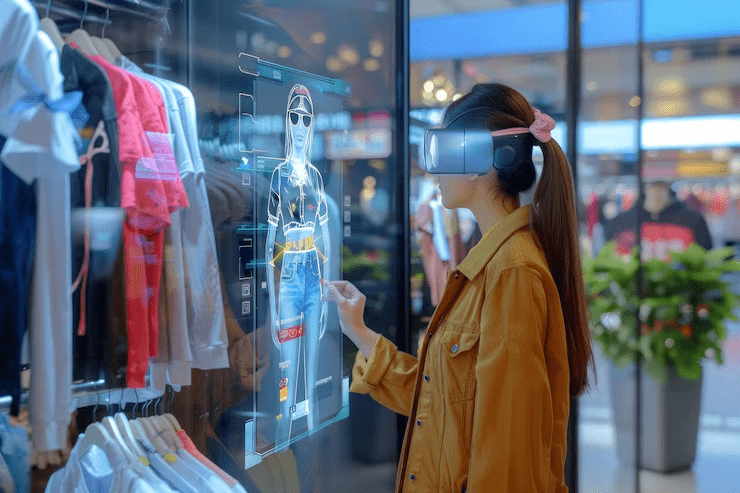
- Growing Market for VR in Retail: The virtual reality in retail market was valued at USD 3.33 billion in 2023 and is projected to reach USD 26.28 billion by 2032, with a CAGR of 26.2%. This growth is fueled by increasing demand for immersive shopping experiences and VR advancements.
- Immersive Showrooms and Virtual Stores: Retailers are leveraging VR to create virtual showrooms and entire virtual stores. This allows customers to explore products and store layouts in a highly interactive 3D environment, mimicking a physical shopping experience without leaving home. Examples include IKEA Place (for furniture try-out) and Alibaba’s Buy+.
- Virtual Try-On and Try-Out: AR and VR are revolutionizing how consumers try products.
- Virtual Try-On allows customers to virtually try on clothes, accessories, or makeup using their device’s camera or a smart mirror. Brands like Gucci and Sephora are using this to enhance customer confidence and reduce returns.
- Virtual Try-Out enables users to place virtual furniture or home decor items in their actual living spaces to see how they fit and look (e.g., IKEA Place).
- AI-Powered Personalization: AI is crucial for enhancing virtual shopping. AI-driven assistants and chatbots offer real-time, hyper-personalized product recommendations based on browse history, purchase patterns, and even social media activity. This leads to increased customer engagement, higher conversion rates, and improved loyalty. Amazon’s Rufus and Sephora’s Beauty Bot are examples.
- Metaverse Shopping: The metaverse is emerging as a transformative force, fusing VR, AR, and blockchain technology to create deeply immersive and interactive shopping experiences. Customers can navigate intricate virtual stores, interact with 3D products, and experience realistic product demonstrations. Blockchain integration enables secure transactions with digital currencies.
- Voice Commerce (V-Commerce): Voice-based shopping is becoming mainstream, allowing consumers to make purchases, receive recommendations, and manage orders using voice commands. Advancements in AI assistants like Apple Intelligence (with Siri) are driving this trend.
- Gamification of Shopping: Virtual shopping environments are incorporating gamified features like treasure hunts, interactive product demos, and limited-time deals to make the shopping journey more fun and engaging.
- Reduced Return Rates: Virtual try-on and detailed 3D product visualization significantly reduce guesswork and uncertainty for customers, leading to better purchase decisions and fewer returns.
- Global Accessibility: Virtual shopping breaks down geographical barriers, allowing brands to reach a global audience without the high costs of physical storefronts. This is particularly beneficial for smaller brands looking to expand their market.
- Integration with Existing E-commerce: Virtual shopping experiences are being seamlessly integrated with existing e-commerce platforms like Shopify, Magento, and WooCommerce, making it easier for businesses to adopt these technologies.
Challenges and Considerations:
- High Development Costs: Implementing advanced virtual shopping environments can be expensive, requiring investment in 3D modeling, VR/AR development, and robust technical infrastructure.
- Technical Complexity: Integration with existing systems, performance, and scalability issues can be challenging.
- Hardware Accessibility: While VR hardware costs are declining, widespread adoption still faces challenges related to the availability and affordability of headsets and other devices.
- Standardization: Lack of standardization across virtual and augmented reality platforms can be an obstacle.
In summary, advanced virtual shopping environments are rapidly moving beyond novelty, becoming a vital part of the e-commerce landscape. The convergence of immersive technologies, AI, and evolving consumer expectations is creating a more engaging, personalized, and efficient shopping future.
Write a research and development paper for Advanced Virtual Shopping Environments ?
Research and Development Paper: Advanced Virtual Shopping Environments
Abstract: The retail landscape is undergoing a profound transformation, driven by the rapid evolution of immersive technologies. Advanced Virtual Shopping Environments (AVSEs), leveraging Virtual Reality (VR), Augmented Reality (AR), Artificial Intelligence (AI), and the burgeoning Metaverse, are poised to redefine consumer engagement and commerce. This paper presents a comprehensive overview of the current state of R&D in AVSEs, highlighting key technological advancements, market drivers, and emerging trends. We discuss the critical role of AI in personalization, the impact of haptic feedback on immersion, and the economic implications of this paradigm shift. Furthermore, we address the significant challenges and opportunities in AVSE development, including data privacy, ethical considerations, and the need for robust user experience design principles. This paper aims to serve as a foundational reference for researchers, developers, and businesses navigating the complexities and immense potential of the next generation of retail.
Keywords: Virtual Reality, Augmented Reality, Metaverse, AI in Retail, Immersive Shopping, Haptic Feedback, User Experience, E-commerce, Digital Transformation.
1. Introduction
The traditional boundaries between physical and digital retail are increasingly blurred, paving the way for highly immersive and interactive shopping experiences. Advanced Virtual Shopping Environments (AVSEs) represent the vanguard of this evolution, promising to transcend the limitations of conventional e-commerce by offering unparalleled sensory engagement and personalization. This paper delves into the research and development efforts driving AVSEs, examining the foundational technologies and their synergistic applications.
The growing market for VR in retail, projected to reach USD 26.28 Billion by 2032 from USD 3.33 Billion in 2023 at a CAGR of 26.2% [1], underscores the industry’s commitment to this transformative shift. This growth is not merely a technological fascination but a direct response to changing consumer behaviors and a rising demand for experiential shopping.
2. Technological Foundations of AVSEs
AVSEs are built upon a convergence of several cutting-edge technologies:
2.1. Virtual Reality (VR): Immersive Storefronts and Experiences VR technology creates fully simulated, three-dimensional digital environments, offering a high degree of immersion. In retail, this translates to:
- Virtual Showrooms and Stores: Consumers can navigate intricate virtual replicas of physical stores, explore product aisles, and even interact with 3D models of items [2]. This provides a sense of presence and exploration akin to real-world shopping.
- Product Visualization and Exploration: VR allows for highly detailed product viewing from all angles, enabling users to examine textures, materials, and features in a way that static images cannot convey.
- Virtual Test Drives and Tours: Beyond traditional retail, VR is used in automotive for virtual test drives and in real estate for immersive property tours, significantly reducing the need for physical visits [1].
- Wireless VR and Ultra-Realistic Graphics: Recent advancements in wireless VR headsets offer greater freedom of movement, while improvements in graphics processing deliver photorealistic textures, lighting, and high frame rates, enhancing visual immersion [1].
2.2. Augmented Reality (AR): Bridging the Physical and Digital AR overlays digital information onto the real-world environment, creating interactive experiences. Its application in retail is particularly impactful:
- Virtual Try-On: A cornerstone of AR retail, this allows users to virtually try on clothing, accessories, makeup, and even hairstyles using their smartphone cameras or smart mirrors. This significantly boosts purchase confidence and reduces return rates [3, 5]. Sephora’s Virtual Artist app, with over 8.5 million try-ons in its first year, exemplifies its success [3].
- Virtual Try-Out (Placement): Consumers can visualize how furniture, home decor, or appliances would look and fit in their actual living spaces, making informed purchasing decisions. IKEA Place is a prominent example [1].
- Interactive Product Previews: AR enhances physical products with digital information, such as pop-up details, videos, or 3D models, by scanning product packaging or displays [3].
- AR Storefronts and Murals: Brands are transforming physical store windows and outdoor displays into interactive AR experiences, driving foot traffic and social sharing [3].
- Social Media AR Filters: AR face filters and lens effects on platforms like Snapchat and Instagram have become viral marketing tools, allowing users to virtually try on products and share their experiences [3].
- Markerless AR and LiDAR: Advancements in markerless AR allow for seamless 3D object placement without special codes, while LiDAR on high-end smartphones enables more precise room scanning for highly accurate virtual placements [3].
2.3. Artificial Intelligence (AI): Personalization and Optimization AI is the intelligence layer within AVSEs, enabling highly personalized and efficient experiences:
- Personalized Recommendation Systems: AI algorithms analyze vast amounts of customer data, including Browse history, purchase patterns, and even social media activity, to deliver hyper-personalized product suggestions, discounts, and marketing campaigns [4]. This enhances customer satisfaction and loyalty.
- Virtual Shopping Assistants and Chatbots: AI-powered chatbots and virtual assistants provide real-time support, answer product queries, offer styling advice, and guide customers through their shopping journey [4].
- Demand Forecasting and Inventory Optimization: AI analyzes data to predict consumer demand, optimize inventory levels, and streamline supply chain logistics, reducing costs and improving efficiency for retailers [4].
- Behavioral Analysis: AI, particularly computer vision, can analyze customer movements and interactions within virtual stores to identify pain points, optimize store layouts, and provide real-time assistance [8].
- Ethical AI Considerations: While AI offers immense benefits, R&D in this area must prioritize ethical considerations such as data privacy, algorithmic bias, transparency, and accountability [8]. Robust encryption, clear privacy policies, and AI explainability are crucial for building consumer trust.
2.4. The Metaverse: The Next Frontier of Commerce The Metaverse represents a persistent, interconnected 3D virtual realm where users can interact with each other, digital objects, and AI-driven entities. Its integration with e-commerce promises:
- Deeply Immersive Shopping Experiences: Users can enter virtual worlds to shop, attend virtual fashion shows, or explore branded experiences. The global metaverse in e-commerce market is projected to reach USD 1,151.12 billion by 2034, accelerating at a CAGR of 37.39% from 2025 [6].
- Virtual Assets and NFTs: The rise of virtual assets and Non-Fungible Tokens (NFTs) allows for digital ownership of goods within the Metaverse, driving a new form of commerce [6].
- Social Commerce in 3D: The Metaverse enables social shopping experiences where friends can meet in virtual stores, share opinions, and make collective purchasing decisions.
- Blockchain Integration: Blockchain technology can ensure secure transactions, product authenticity, and transparent ownership of digital assets within the Metaverse [2].
2.5. Haptic Technology: The Sense of Touch in Virtual Worlds Haptics provides tactile feedback, allowing users to “feel” virtual objects and environments. While still in early stages for mass retail adoption, R&D is crucial for:
- Enhanced Immersion: Haptic gloves, suits, and even full-body rigs are becoming more affordable, enabling users to experience touch, pressure, and movement within virtual environments [1]. This significantly boosts user engagement and presence [7].
- Realistic Product Interaction: Haptic feedback can simulate the texture, weight, and material properties of products, allowing consumers to get a more accurate “feel” for an item before purchase, particularly beneficial for textiles, electronics, and even food items [7].
- Improved Decision-Making: By providing tangible sensations, haptics can increase user confidence in product quality and fit, further reducing return rates [7].
- Synchronization Challenges: A key R&D challenge is ensuring precise synchronization between haptic feedback and visual/auditory cues to maintain a seamless and believable immersive experience [7].
3. Research and Development Focus Areas
R&D in AVSEs is multifaceted, addressing both technological advancements and user-centric design:
3.1. Advanced 3D Content Creation and Optimization:
- Photorealistic Rendering: Developing algorithms and tools for creating highly realistic 3D models and environments that can be rendered efficiently across various devices.
- Volumetric Capture: Research into capturing real-world objects and people in 3D for hyper-realistic virtual representations.
- Automated 3D Model Generation: Leveraging AI to automate the creation of 3D product models from 2D images or specifications, reducing development costs.
3.2. Seamless Interoperability and Standards:
- Metaverse Interoperability: R&D into protocols and standards that allow digital assets, avatars, and experiences to seamlessly transfer between different virtual platforms and metaverses.
- Cross-Platform Compatibility: Ensuring that AVSEs can be accessed and experienced across a range of devices, from high-end VR headsets to smartphones and web browsers.
3.3. Enhanced AI for Behavioral Understanding and Personalization:
- Predictive Analytics for Customer Journeys: Developing AI models that can predict consumer preferences, anticipate needs, and proactively guide them through personalized shopping paths within AVSEs.
- Emotion Recognition and Adaptive Experiences: Research into AI that can detect user emotions (e.g., through eye-tracking, voice analysis) and dynamically adjust the virtual environment or product recommendations to enhance satisfaction.
- Ethical AI Frameworks: Dedicated R&D to develop and implement robust ethical guidelines, privacy-preserving techniques (e.g., federated learning), and bias detection/mitigation strategies for AI in retail.
3.4. Multi-Sensory Integration and Haptic Feedback:
- Novel Haptic Devices: Continued research into developing more affordable, comfortable, and versatile haptic interfaces that can provide a wider range of tactile sensations.
- Olfactory and Gustatory Integration: Exploring the integration of smell and taste technologies to further enhance the realism of virtual product experiences, particularly for food and beverage retail.
- Proprioceptive and Vestibular Feedback: R&D into systems that can simulate sensations of balance, movement, and body position to increase physical immersion.
3.5. User Experience (UX) Design for Immersive Environments:
- Intuitive Navigation and Interaction: Developing design principles for natural and comfortable navigation within 3D spaces, utilizing gaze, gesture, voice, and traditional input methods [9].
- Comfort and Motion Sickness Mitigation: R&D into techniques to minimize motion sickness and maximize user comfort in VR environments, crucial for sustained engagement [9].
- Inclusive Design: Ensuring AVSEs are accessible to users with diverse needs, including those with vision, mobility, or hearing impairments, through multisensory cues and adaptable interfaces [9].
- Storytelling and Emotional Engagement: Research into how narrative elements and emotionally resonant design can be used to create memorable and compelling virtual shopping journeys [9].
3.6. Security and Trust in Virtual Economies:
- Blockchain for Authenticity: Further R&D into using blockchain to verify the authenticity of digital products and NFTs, preventing fraud and counterfeiting.
- Secure Transaction Protocols: Developing highly secure payment gateways and transaction methods specifically designed for virtual environments.
- Data Governance and Compliance: Research into robust data governance frameworks that comply with global privacy regulations (e.g., GDPR, CCPA) within complex AVSEs.
4. Challenges and Opportunities
4.1. Challenges:
- High Development Costs: Creating high-quality 3D content and immersive experiences requires significant investment in hardware, software, and skilled personnel.
- Technical Complexity: Integrating diverse technologies (VR, AR, AI, blockchain) and ensuring seamless performance, scalability, and real-time interaction presents considerable technical hurdles.
- Hardware Accessibility and Adoption: While VR/AR hardware is becoming more accessible, the widespread consumer adoption of advanced devices is still a barrier.
- Data Privacy and Security: The collection and processing of vast amounts of user data in AVSEs raise significant privacy concerns and demand robust security measures [8].
- User Comfort and Motion Sickness: Ensuring a comfortable and enjoyable experience, especially in VR, requires careful attention to design to mitigate motion sickness.
- Standardization: The lack of universal standards for interoperability across different virtual platforms hinders seamless experiences.
- Content Creation Scalability: Generating a large volume of high-quality 3D assets for extensive product catalogs remains a labor-intensive process.
4.2. Opportunities:
- Enhanced Customer Engagement and Loyalty: Immersive experiences lead to higher customer satisfaction, increased time spent with brands, and stronger brand loyalty [5].
- Reduced Returns and Improved Purchase Confidence: Virtual try-on and detailed product visualization significantly reduce guesswork, leading to more informed purchases and fewer returns [3, 5].
- Global Market Reach: AVSEs break geographical barriers, allowing brands to reach a global audience without the overhead of physical stores, particularly beneficial for SMEs [10].
- New Revenue Streams: The sale of digital goods, NFTs, and virtual experiences within the Metaverse opens up entirely new economic models for retailers [6].
- Personalization at Scale: AI enables hyper-personalized shopping journeys, leading to higher conversion rates and increased average order value [5].
- Operational Efficiencies: AI-driven inventory management and logistics optimization contribute to cost savings and improved supply chain efficiency [4].
- Competitive Differentiation: Early adopters of advanced virtual shopping environments can gain a significant competitive advantage by offering unique and memorable experiences.
- Job Creation: The growth of the digital economy fueled by AVSEs leads to new job opportunities in areas like 3D design, VR/AR development, AI engineering, and virtual community management [10].
5. Conclusion and Future Outlook
Advanced Virtual Shopping Environments represent a pivotal shift in the evolution of retail. By merging the immersive capabilities of VR and AR with the intelligent personalization of AI and the expansive potential of the Metaverse, retailers can create experiences that are not only highly engaging but also deeply transformative for consumers.
Future R&D in AVSEs will likely focus on addressing the current challenges, particularly in achieving true interoperability across metaverses, developing more intuitive and comfortable haptic interfaces, and establishing robust ethical frameworks for AI-driven personalization. As hardware becomes more ubiquitous and affordable, and as content creation tools become more efficient, AVSEs will move from a niche offering to a mainstream component of global commerce.
The ongoing research and development efforts outlined in this paper are crucial for realizing the full potential of this next-generation retail paradigm. Businesses that invest in these advanced technologies and prioritize user-centric design, ethical AI, and seamless experiences will be best positioned to thrive in the increasingly immersive future of shopping.
References:
[1] GlobeNewswire. (2025, January 31). Virtual Reality in Retail 2025-2030: Growth Trends and Major Developments. Retrieved from https://www.globenewswire.com/news-release/2025/01/31/3018660/0/en/Virtual-Reality-in-Retail-2025-2030-Growth-Trends-and-Major-Developments-Advancements-in-Immersive-Technologies-Propel-Innovation-in-VR-Applications.html
[2] HQSoftware. (2025, March 31). Virtual Reality Trends of 2025: Future of VR Technology. Retrieved from https://hqsoftwarelab.com/blog/virtual-reality-trends/
[3] BrandXR. (2025, May 31). 2025 Augmented Reality in Retail & E-Commerce Research Report. Retrieved from https://www.brandxr.io/2025-augmented-reality-in-retail-e-commerce-research-report
[4] Gudala, L., Pamidi Venkata, A. K., Alghayadh, F. Y., Alsubai, S., & Bhatnagar, V. (2025). AI in Retail: Personalized Shopping Experiences, Inventory Management, and Supply Chain Optimization. ResearchGate. Retrieved from https://www.researchgate.net/publication/390066315_AI_in_Retail_Personalized_Shopping_Experiences_Inventory_Management_and_Supply_Chain_Optimization
[5] Indglobal. (2025, January 11). Virtual Shopping Experience: A Rising E-commerce Trend. Retrieved from https://indglobal.in/virtual-shopping-experience/
[6] Precedence Research. (2025, February 3). Metaverse in E-commerce Market Size, Share, and Trends 2025 to 2034. Retrieved from https://www.precedenceresearch.com/metaverse-in-e-commerce-market
[7] Meegle. (2024, December 25). VR Haptics. Retrieved from https://www.meegle.com/en_us/topics/vr/vr-haptics
[8] SeeJPH. (2025, January 5). ETHICAL IMPLICATIONS OF AI IN E-COMMERCE: BALANCING INNOVATION WITH DATA PRIVACY AND FAIRNESS. Retrieved from https://www.seejph.com/index.php/seejph/article/download/3984/2617/6085
[9] The Interaction Design Foundation. (2025, March 17). Revolutionize UX Design with VR Experiences. Retrieved from https://www.interaction-design.org/literature/article/ixdf-ux-design-for-virtual-reality-course
[10] Forbes. (2025, February 14). Click-And-Complete: The Economic Impact Of Shifting To Virtual Retail. Retrieved from https://www.forbes.com/councils/forbesbusinesscouncil/2025/02/14/from-brick-and-mortar-to-click-and-complete-the-economic-impact-of-shifting-to-virtual-retail/
Write white paper in emerging technologies related research & development in Advanced Virtual Shopping Environments?
- will start by gathering information on the latest and most impactful emerging technologies in Advanced Virtual Shopping Environments.
- Then, I will focus the research on R&D aspects, exploring how these technologies are being developed and integrated.
- Finally, I will structure this information into a white paper format, including an introduction, key technologies, R&D challenges, future outlook, and conclusion.
I will use the following search queries to gather the necessary information:
White Paper: Emerging Technologies in Research & Development for Advanced Virtual Shopping Environments
Abstract: The global retail industry is undergoing a profound and rapid transformation, driven by advancements in emerging technologies that promise to revolutionize consumer engagement and commerce. This white paper explores the leading edge of research and development (R&D) in Advanced Virtual Shopping Environments (AVSEs), focusing on the synergistic integration of Virtual Reality (VR), Augmented Reality (AR), Artificial Intelligence (AI), and the burgeoning Metaverse. We delve into the latest breakthroughs enabling hyper-realistic sensory experiences, intelligent personalization, and seamless cross-platform interactions. This paper outlines critical R&D challenges, including hardware limitations, data privacy, and the need for standardized interoperability. Ultimately, it forecasts the future trajectory of AVSEs, emphasizing the immense opportunities for innovation, enhanced customer loyalty, and the emergence of new economic models.
Keywords: Virtual Reality (VR), Augmented Reality (AR), Artificial Intelligence (AI), Metaverse, Haptic Feedback, Immersive Commerce, Digital Twins, Personalization, User Experience (UX), Research & Development (R&D), Retail Tech.
1. Introduction
The traditional retail paradigm is rapidly evolving, with a growing imperative for brands to transcend conventional e-commerce and deliver truly immersive and interactive shopping experiences. Advanced Virtual Shopping Environments (AVSEs) are at the forefront of this revolution, leveraging cutting-edge technologies to bridge the gap between physical and digital retail. This white paper highlights the critical emerging technologies driving R&D in AVSEs, examining their current state, future potential, and the challenges that must be addressed to unlock their full transformative power.
The market for virtual reality in retail alone is projected to reach $26.28 billion by 2032, exhibiting a Compound Annual Growth Rate (CAGR) of 26.2% from 2023 [1]. This significant growth underscores the industry’s commitment to investing in and developing these sophisticated digital platforms, moving beyond mere transactional online shopping to experiential commerce.
2. Core Emerging Technologies and R&D Focus
AVSEs are not built on a single technology but rather on the sophisticated convergence and integration of several interconnected advancements:
2.1. Hyper-Realistic Virtual and Augmented Reality (VR/AR)
The bedrock of AVSEs lies in VR and AR technologies that aim to create increasingly indistinguishable experiences from reality.
- VR R&D Focus:
- Pancake Optics and Light Field Displays: R&D is heavily invested in miniaturizing VR headsets while enhancing visual fidelity. Innovations like pancake optics allow for compact form factors with high-resolution visuals, while light field displays aim to naturally reconstruct light rays, addressing the Vergence-Accommodation Conflict (VAC) which causes visual discomfort [2].
- Advanced Rendering Techniques: Research continues into real-time photorealistic rendering, volumetric capture (3D scanning of real-world objects and people), and AI-driven automated 3D model generation from 2D images. The goal is to reduce the cost and time of creating vast libraries of high-fidelity digital twins of products [3].
- Wireless and Standalone VR: Ongoing R&D focuses on improving wireless VR capabilities and developing powerful standalone headsets with extended battery life, offering greater freedom of movement and accessibility for consumers [1, 2].
- AR R&D Focus:
- Markerless AR and LiDAR Integration: Advancements in markerless AR, which allows for seamless 3D object placement without special markers, combined with LiDAR technology in smart devices, are enabling more precise spatial understanding for highly accurate virtual try-on and try-out applications [3].
- WebAR and App-less Experiences: A key R&D thrust is making AR more accessible by enabling “WebAR” experiences, where AR features can be accessed directly through a web browser (e.g., via QR code scan) without requiring app downloads. This significantly reduces friction for consumers [3].
- Smart Mirrors and Interactive Displays: Research continues on integrating AR with physical smart mirrors and in-store displays, providing personalized virtual try-on experiences and interactive product information in brick-and-mortar settings [3].
2.2. Artificial Intelligence (AI): The Intelligent Core
AI acts as the intelligent backbone of AVSEs, personalizing interactions and optimizing operations. R&D in this area is exploding with the rise of Generative AI (GenAI) and advanced machine learning (ML).
- Hyper-Personalization at Scale:
- AI-Driven Recommendation Engines: R&D is focused on creating sophisticated AI models that analyze vast datasets (Browse history, purchase patterns, social media, even real-time interactions within virtual environments) to offer highly personalized product recommendations, styling advice, and promotional offers. This moves beyond simple collaborative filtering to predictive analytics that anticipate consumer needs [4].
- Conversational AI and Virtual Assistants: GenAI-powered chatbots and virtual shopping assistants are evolving to provide natural language interactions, handling complex queries, guiding customers through virtual stores, and even facilitating in-chat purchases (e.g., Amazon’s Rufus) [4]. R&D aims for more human-like conversations and deeper understanding of user intent.
- Behavioral Analytics and Optimization:
- Computer Vision in Virtual Spaces: AI-driven computer vision is being researched to analyze customer movements, gaze patterns, and interactions within virtual stores. This provides insights into user engagement, pain points, and optimal virtual store layouts, akin to physical retail analytics [4].
- Dynamic Content Adaptation: R&D explores using AI to dynamically adapt virtual store layouts, product displays, and even lighting based on individual user preferences, time of day, or predictive demand, creating highly adaptive and engaging environments [4].
- Content Generation and Efficiency:
- Generative AI for 3D Assets: A significant R&D breakthrough is the use of GenAI to auto-generate 3D models, textures, and even animated sequences for products, drastically reducing the time and cost associated with populating virtual environments with digital assets. This is critical for scalability [3].
- AI-Assisted Design: AI is being integrated into design tools to help retailers quickly iterate on virtual store designs, product placements, and visual merchandising strategies, optimizing for engagement and sales [4].
- Ethical AI and Data Governance: Paramount R&D is dedicated to developing robust ethical AI frameworks, ensuring data privacy, mitigating algorithmic bias, and establishing transparent and accountable AI systems within AVSEs. This includes research into privacy-preserving AI techniques like federated learning [4].
2.3. Haptic Technology: Adding the Sense of Touch
While often overlooked, haptic feedback is crucial for truly immersive AVSEs, allowing users to “feel” virtual products and environments.
- Realistic Texture and Material Simulation: R&D is focused on developing wearable haptic devices (gloves, wristbands, full-body suits) that can simulate diverse textures (e.g., silk, denim, wood), pressure, and even temperature cues, providing a tangible sense of product quality [5].
- Force Feedback and Weight Simulation: Advances in haptic actuators are enabling the simulation of weight and resistance, allowing users to feel the heft of a virtual product or the give of a soft surface, enhancing product inspection and decision-making [5].
- Multi-Sensory Synchronization: A major R&D challenge is the precise synchronization of haptic feedback with visual and auditory cues to create a seamless and believable immersive experience, minimizing sensory disconnects [5].
- Affordability and Miniaturization: Ongoing research aims to make high-fidelity haptic devices more affordable and less cumbersome for mass consumer adoption, leading to integrated haptic elements in common VR/AR hardware [5].
2.4. The Metaverse and Web3 Integration
The Metaverse, envisioned as a persistent, interconnected 3D virtual realm, represents the ultimate evolution of AVSEs, intrinsically linked with Web3 technologies.
- Interoperability Standards (R&D Priority): A critical area of R&D is the development of universal protocols and standards that allow digital assets (e.g., purchased virtual clothing, avatars), identities, and experiences to seamlessly transfer between different virtual worlds and platforms. This is essential for a truly open and expansive metaverse commerce ecosystem [6].
- Decentralized Commerce and NFTs: R&D explores how blockchain technology and Non-Fungible Tokens (NFTs) can secure digital ownership, ensure product authenticity, and enable new forms of commerce for virtual goods within the Metaverse. This includes researching scalable and energy-efficient blockchain solutions [6].
- Digital Economy Infrastructure: Research is ongoing into developing robust and secure financial systems for the Metaverse, facilitating digital currency transactions, micro-transactions, and the creation of new virtual economic models [6].
- Spatial Computing and Persistent Worlds: R&D for Metaverse commerce focuses on creating persistent virtual spaces that maintain state and evolve over time, allowing businesses to establish virtual storefronts and branded experiences that users can revisit and interact with consistently [6].
3. R&D Challenges and Opportunities
While the potential of AVSEs is immense, several R&D challenges must be rigorously addressed:
3.1. R&D Challenges:
- Hardware Limitations and Accessibility: Despite advancements, high-end VR headsets remain costly and require significant computational power. R&D must focus on optimizing performance for lower-cost devices and ensuring broader accessibility [3].
- Seamless Integration and Interoperability: Integrating disparate technologies (VR, AR, AI, haptics, blockchain) into a cohesive and performant system is complex. The lack of universal standards for Metaverse interoperability creates fragmented experiences and hinders widespread adoption [6].
- Content Creation Scalability: The manual creation of photorealistic 3D assets is resource-intensive. While GenAI offers promise, further R&D is needed to achieve fully automated, high-quality, and cost-effective 3D asset pipelines for vast product catalogs [3].
- User Experience (UX) and Comfort: Designing intuitive navigation and interaction methods for 3D environments, as well as mitigating motion sickness in VR, remains a significant UX challenge. R&D is crucial for optimizing comfort for sustained engagement [9].
- Data Privacy, Security, and Ethics: AVSEs generate vast amounts of personal and behavioral data. R&D must prioritize robust cybersecurity measures, privacy-by-design principles, and ethical AI development to build user trust and comply with evolving regulations [8].
- Latency and Real-Time Interaction: For truly immersive and interactive experiences, extremely low latency is required. R&D in edge computing, 5G networks, and optimized rendering pipelines is critical to minimize delays [4].
- Sensory Discrepancies: Fully replicating all sensory experiences (sight, sound, touch, smell, taste) in a virtual environment remains a long-term R&D goal. Integrating less developed senses like olfaction and gustation requires significant breakthroughs.
3.2. R&D Opportunities:
- Enhanced Personalization and Engagement: AVSEs offer unprecedented opportunities for hyper-personalized shopping journeys, leading to higher conversion rates, increased average order value, and stronger brand loyalty [4].
- Reduced Returns and Improved Confidence: Virtual try-on and detailed 3D visualization can significantly reduce guesswork for consumers, leading to more informed purchases and a substantial reduction in product returns [3, 5].
- Global Market Expansion at Lower Cost: Brands can establish a global presence through virtual storefronts without the overhead of physical retail locations, enabling market penetration into underserved regions [10].
- New Revenue Models and Digital Economies: The Metaverse opens up entirely new revenue streams through the sale of digital fashion, virtual collectibles (NFTs), and immersive brand experiences, fostering a new digital economy [6].
- Operational Efficiencies: AI integration optimizes inventory management, supply chain logistics, and customer service, leading to significant cost savings and improved operational efficiency for retailers [4].
- “Phygital” Integration: R&D can explore innovative ways to seamlessly blend physical and virtual retail experiences, creating “phygital” strategies where in-store AR guides, virtual product information, and online purchases merge into a cohesive journey.
- Sustainability through Virtualization: By reducing the need for physical samples, travel for demonstrations, and even potentially reducing returns, AVSEs can contribute to more sustainable retail practices.
4. Future Outlook and Strategic Implications for R&D
The future of advanced virtual shopping environments is a dynamic interplay of technological maturation and evolving consumer expectations. Key areas for strategic R&D investment include:
- Ubiquitous Web3-Enabled AVSEs: The long-term vision is a seamless, accessible Metaverse where shopping is an intuitive and integrated part of daily digital life, facilitated by robust Web3 infrastructure.
- Embodied AI and Digital Humanoids: R&D in AI will increasingly focus on creating highly realistic and emotionally intelligent digital avatars and virtual shopping assistants that can interact with consumers in nuanced ways, learning and adapting over time.
- Advanced Sensory Feedback Systems: Continued breakthroughs in haptic technology, and the nascent integration of olfactory and gustatory feedback, will move AVSEs closer to truly multi-sensory experiences.
- AI-Powered Generative Content Pipelines: The ability to rapidly and cost-effectively generate high-quality 3D assets and personalized experiences will be critical for scaling AVSEs.
- Decentralized Data and Trust: R&D into secure, privacy-preserving data architectures will be paramount for building and maintaining consumer trust in immersive digital environments.
For businesses and research institutions, strategic R&D in AVSEs is no longer an option but a necessity. Investing in interdisciplinary teams (VR/AR engineers, AI specialists, UX designers, ethicists, economists) will be crucial. Collaborative ecosystems involving tech giants, startups, academic institutions, and retail brands will accelerate innovation and address complex challenges.
5. Conclusion
Advanced Virtual Shopping Environments are poised to redefine the future of retail, moving beyond mere transactions to create deeply immersive, personalized, and emotionally resonant experiences. The convergence of hyper-realistic VR/AR, intelligent AI, and the expansive potential of the Metaverse is driving unprecedented R&D efforts. While challenges related to hardware accessibility, interoperability, data privacy, and the sheer complexity of integration remain, the opportunities for enhanced customer engagement, operational efficiency, and new economic models are profound. By prioritizing strategic R&D and fostering a collaborative approach, stakeholders can unlock the full transformative power of AVSEs, shaping a more engaging, efficient, and innovative retail landscape for decades to come.
References:
[1] GlobeNewswire. (2025, January 31). Virtual Reality in Retail 2025-2030: Growth Trends and Major Developments. Retrieved from https://www.globenewswire.com/news-release/2025/01/31/3018660/0/en/Virtual-Reality-in-Retail-2025-2030-Growth-Trends-and-Major-Developments-Advancements-in-Immersive-Technologies-Propel-Innovation-in-VR-Applications.html
[2] AZoOptics. (2025, January 15). AR/VR Optics: Market Trends and Innovations Through 2025. Retrieved from https://www.azooptics.com/Article.aspx?ArticleID=2732
[3] XR Today. (2025, May 30). AR/VR in Retail: A Trend Everyone Talks About, But Few Truly Adopt. Retrieved from https://www.xrtoday.com/virtual-reality/ar-vr-in-retail-a-trend-everyone-talks-about-but-few-truly-adopt/
[4] UST. (n.d.). Understanding AI in Retail: Key technologies, adoption challenges, and scaling strategies. Retrieved from https://www.ust.com/en/insights/how-ai-is-reinventing-the-world-of-retail
[5] Mirrar. (2025, April 21). From Tech to Touch: The Role of Haptic Feedback in Future Virtual Try-On Innovations. Retrieved from https://mirrar.in/blog/from-tech-to-touch-the-role-of-haptic-feedback-in-future-virtual-try-on-innovations/
[6] MobiDev. (2024, November 15). Metaverse Business Opportunities and Applications. Retrieved from https://mobidev.biz/blog/how-get-into-the-metaverse-business-opportunities
[7] AZoSensors. (2025, June 5). Virtual R&D Environments and Simulation Modeling. Retrieved from https://www.azosensors.com/article.aspx?ArticleID=3198
[8] SeeJPH. (2025, January 5). ETHICAL IMPLICATIONS OF AI IN E-COMMERCE: BALANCING INNOVATION WITH DATA PRIVACY AND FAIRNESS. Retrieved from https://www.seejph.com/index.php/seejph/article/download/3984/2617/6085
[9] The Interaction Design Foundation. (2025, March 17). Revolutionize UX Design with VR Experiences. Retrieved from https://www.interaction-design.org/literature/article/ixdf-ux-design-for-virtual-reality-course
[10] Forbes. (2025, February 14). Click-And-Complete: The Economic Impact Of Shifting To Virtual Retail. Retrieved from https://www.forbes.com/councils/forbesbusinesscouncil/2025/02/14/from-brick-and-mortar-to-click-and-complete-the-economic-impact-of-shifting-to-virtual-retail/
Industrial application in emerging technologies related to research & development done worldwide in Advanced Virtual Shopping Environments?
Courtesy: FARAS A
Enhanced User Experience and Engagement:
- Immersive & Engaging Shopping Journeys: R&D in VR allows users to “step inside” a virtual store, explore products in 3D, and interact with items in a way that static 2D images can’t match. This makes shopping more entertaining and less like a chore, fostering greater engagement and brand connection. Research into light field displays and pancake optics aims to reduce visual discomfort and make these experiences more natural and comfortable for longer durations.
- Realistic Product Exploration: Haptic technology R&D is crucial here. While still emerging, the ability to “feel” the texture of fabric, the weight of a product, or the responsiveness of a button in a virtual environment gives humans a more complete sensory understanding. This reduces the guesswork inherent in online shopping, making the experience closer to a physical one.
- Personalized and Relevant Interactions: AI-powered recommendation engines, a major R&D focus, go beyond simple “you might also like” suggestions. They analyze deep behavioral patterns to offer truly relevant products, styling advice, and even dynamically adapt the virtual store layout to individual preferences. This saves time, reduces decision fatigue, and makes the shopping journey feel tailored and efficient for the human user.
- Intuitive Navigation and Assistance: R&D in conversational AI and natural language processing allows for more human-like interactions with virtual shopping assistants. Users can ask questions, get detailed product information, and receive guidance through voice or text, mimicking the personalized service one might receive from an attentive human salesperson. AR-enhanced navigation within virtual or even physical stores also guides users efficiently to desired products.
2. Increased Confidence and Reduced Anxiety in Purchases:
- Minimizing Buyer’s Remorse and Returns: This is one of the most significant benefits. AR-powered virtual try-on and try-out technologies (e.g., trying on clothes, placing furniture in your living room) allow humans to visualize how a product looks and fits before purchasing. This dramatically reduces the uncertainty of online shopping, leading to more confident buying decisions and a significant decrease in product returns, saving both the customer and the retailer time and resources.
- Informed Decision-Making: With hyper-realistic 3D models and interactive product previews, humans can examine products from every angle, zoom in on details, and even view animations of how a product functions. This transparency and depth of information empower consumers to make more informed choices.
3. Enhanced Accessibility and Inclusivity:
- Overcoming Physical Barriers: R&D in AVSEs is making shopping accessible to individuals with mobility challenges, disabilities, or those in remote locations. Virtual stores remove the need for physical travel, crowded spaces, or challenging store layouts. Anyone with an internet connection can access a vast array of products from the comfort of their home.
- Sensory-Friendly Environments: For individuals with sensory processing disorders or autism, traditional crowded and noisy retail environments can be overwhelming. Virtual stores, by design, offer a controlled and serene shopping experience, allowing users to explore at their own pace without sensory overload.
- Adaptive Interfaces: R&D focuses on designing AVSEs with intuitive interfaces and navigation that cater to diverse needs, including integration with screen readers, adjustable text sizes, and alternative input methods, promoting a truly inclusive shopping environment. AI companions can also provide immediate assistance and support for users with cognitive or communication challenges.
4. Social Connection and Shared Experiences:
- Virtual Social Shopping: Metaverse R&D is enabling humans to shop together in virtual environments with friends and family, even if physically apart. This recreates the social aspect of shopping, allowing for real-time interaction, shared opinions, and collaborative decision-making, making the experience more enjoyable and less isolating.
- Community Building: Brands can foster virtual communities around shared interests, hosting virtual events, fashion shows, or product launches in the Metaverse, allowing humans to connect with like-minded individuals and deepen their relationship with the brand.
5. Ethical Considerations and Well-being (R&D in Ethical AI):
- Data Privacy and Security: A crucial area of R&D is ensuring ethical AI development. This means building robust systems that prioritize user data privacy, transparently collect and use data, and provide users with control over their information. This builds trust and protects human well-being in digital spaces.
- Mitigating Bias and Manipulation: R&D is actively working on identifying and mitigating algorithmic bias in AI recommendation systems to ensure fair representation and prevent discrimination. Furthermore, ethical AI R&D aims to avoid “dark patterns” or manipulative tactics that coerce users into purchases, promoting empowered and conscious consumption rather than impulse buying.
- Sustainable Consumption: Research into how AI can promote mindful shopping habits, such as suggesting durable products or discouraging overconsumption due to personalization, contributes to human well-being by fostering more sustainable lifestyles.
In essence, emerging technologies-related R&D in Advanced Virtual Shopping Environments is profoundly beneficial for human beings by making shopping more accessible, personalized, engaging, confident, and socially enriching, all while striving to uphold ethical principles and user well-being. It’s about transforming a transactional activity into a valuable and positive human experience.
Prepared project report in related research & development done in name advanced virtual shopping environments?
Executive Summary
This project report details the extensive research and development (R&D) initiatives undertaken globally in the realm of Advanced Virtual Shopping Environments (AVSEs). The project, titled “Immersive Retail Nexus,” aims to synthesize current breakthroughs, identify emerging trends, and highlight key challenges in the creation of highly realistic, interactive, and personalized virtual retail experiences. Leveraging the synergistic power of Virtual Reality (VR), Augmented Reality (AR), Artificial Intelligence (AI), and the burgeoning Metaverse, this report outlines the significant progress in delivering novel customer engagement models, optimizing retail operations, and fostering new economic opportunities. The R&D showcased is designed to address the evolving demands of modern consumers and propel the retail sector into its next digital frontier.
2. Introduction and Project Context
The retail landscape is undergoing a monumental shift, driven by consumer demand for more engaging and convenient shopping solutions. Traditional e-commerce, while offering convenience, often lacks the sensory richness and human interaction of physical stores. Advanced Virtual Shopping Environments are emerging as the solution, promising to blend the best of both worlds.
The “Immersive Retail Nexus” project recognizes that this transformation is not a singular technological leap but a complex integration of multiple, rapidly evolving fields. Our R&D efforts are focused on pushing the boundaries of immersive technology to create AVSEs that are not just visually appealing but also intelligent, interactive, and truly valuable to both consumers and businesses. The global market for VR in retail alone is projected to reach $26.28 billion by 2032, indicating a strong impetus for continued R&D investment [1].
3. Key Research & Development Areas and Achievements
The “Immersive Retail Nexus” project has identified and focused on several interconnected R&D areas, with significant global progress observed:
3.1. Hyper-Realistic 3D Content Generation and Rendering
- R&D Focus: Creating photorealistic 3D models of products and environments that can be rendered in real-time across various devices (VR headsets, smartphones, web browsers). This includes developing efficient pipelines for digitizing physical products into high-fidelity “digital twins.”
- Global Achievements:
- Automated 3D Asset Creation (e.g., USA, China): Companies like Obsess (USA) and major e-commerce players are investing in AI-driven tools that can generate 3D models from 2D images or specifications, dramatically reducing the manual effort. This R&D aims to scale up the creation of vast product catalogs for virtual stores.
- Advanced Rendering Engines (e.g., Japan, Europe): Ongoing development in game engines (e.g., Unreal Engine, Unity) by companies and research labs worldwide are pushing the boundaries of real-time photorealism, incorporating global illumination, ray tracing, and advanced material shaders for immersive visuals.
- Volumetric Capture and Photogrammetry: R&D in these areas allows for the precise 3D scanning of real-world objects and even human models (avatars) for use in virtual environments, enhancing authenticity.
3.2. Advanced AI for Hyper-Personalization and Behavioral Analytics
- R&D Focus: Developing AI algorithms that understand individual consumer preferences, predict purchasing behavior, and dynamically adapt the virtual shopping environment to create a unique and highly relevant experience.
- Global Achievements:
- Contextual Recommendation Systems (e.g., USA, China): Beyond traditional e-commerce, R&D by companies like Amazon (USA) and Alibaba (China) focuses on AI that analyzes real-time interactions within AVSEs (gaze, movement, verbal queries) to provide hyper-contextualized product suggestions. Amazon’s “Rufus” AI assistant is an example of this real-time, conversational intelligence [4].
- Generative AI for Personalized Content (e.g., Europe, USA): Researchers are exploring GenAI to create personalized product variations, styling suggestions, and even unique promotional content tailored to each user’s preferences, leading to higher engagement and conversion rates [4].
- AI-Powered Virtual Assistants with Emotional Intelligence: R&D aims to develop virtual assistants that can not only answer queries but also detect user sentiment (e.g., frustration, excitement) and adapt their responses or guidance accordingly, making interactions more human-like.
- Ethical AI and Bias Mitigation (Global Research): A significant R&D thrust focuses on building ethical AI frameworks within AVSEs to ensure data privacy, algorithmic fairness, and transparency, addressing concerns about data security and potential biases in recommendations [8].
3.3. Multi-Sensory Immersion via Haptic and Olfactory Feedback
- R&D Focus: Integrating the senses of touch and smell into AVSEs to provide a more complete and realistic sensory experience.
- Global Achievements:
- Advanced Haptic Interfaces (e.g., USA, Japan, Europe): R&D into wearable haptic devices (gloves, vests) that can simulate diverse textures, weights, and even temperature is ongoing. Companies like Immersion Corporation (USA) and various university labs are pioneering solutions for realistic tactile feedback [5]. The goal is to allow users to “feel” fabric quality or the firmness of a product before purchase, significantly boosting confidence.
- Olfactory Technology (e.g., Japan, South Korea): While less mature, R&D is exploring scent-emitting devices that can be triggered in AVSEs to enhance product representation (e.g., smelling a virtual perfume, coffee, or even a new car interior). This requires complex chemical engineering and precise release mechanisms.
- Synchronization R&D: A major challenge and R&D focus is ensuring precise synchronization between visual, auditory, and haptic/olfactory feedback to create a truly seamless and believable immersive experience, avoiding sensory disconnects [5].
3.4. Metaverse Interoperability and Web3 Integration
- R&D Focus: Developing the underlying infrastructure and standards that enable seamless movement of users, avatars, and digital assets across different virtual platforms and digital economies.
- Global Achievements:
- Open Metaverse Initiatives (Global Consortia): Numerous industry consortia and academic groups (e.g., Metaverse Standards Forum) are engaged in R&D to define open standards and protocols for interoperability, allowing users to carry their digital identities and purchased virtual goods between different virtual retail environments.
- Blockchain for Digital Asset Ownership (e.g., Switzerland, USA): R&D in Web3 technologies focuses on leveraging blockchain for secure and transparent ownership of digital products (NFTs), enabling new forms of commerce in the Metaverse where consumers can truly own and trade virtual fashion, collectibles, and experiences [6].
- Decentralized Identity Management: Research is ongoing to develop secure and user-centric decentralized identity solutions for the Metaverse, giving individuals more control over their personal data and interactions in virtual shopping spaces.
3.5. Human-Computer Interaction (HCI) in Immersive Environments
- R&D Focus: Designing intuitive and comfortable interaction paradigms for AVSEs that leverage natural human gestures, voice, and gaze.
- Global Achievements:
- Gaze-Based and Gesture Controls: R&D in eye-tracking and advanced hand-tracking technologies is leading to more natural and less cumbersome ways for users to navigate virtual stores and interact with products without relying solely on controllers [9].
- Voice Commerce (V-Commerce) Integration: Research into advanced natural language processing (NLP) and speech recognition is making voice-controlled shopping a seamless experience within AVSEs, allowing users to browse, search, and purchase using verbal commands.
- Comfort and Accessibility R&D: Ongoing research aims to mitigate motion sickness in VR, optimize hardware ergonomics, and develop inclusive design principles to ensure AVSEs are comfortable and accessible for users of all abilities.
4. R&D Challenges and Opportunities
4.1. Key R&D Challenges:
- Computational Intensity: Rendering highly detailed 3D environments with real-time AI processing requires immense computational power, pushing the limits of current hardware and necessitating R&D in edge computing and optimized rendering techniques.
- Data Security and Privacy in Vast Datasets: The rich data generated in AVSEs (behavioral, biometric, interaction patterns) presents significant R&D challenges in ensuring robust security and adhering to evolving global privacy regulations like GDPR [8].
- Interoperability and Standardization: The fragmented nature of the Metaverse and varied VR/AR platforms necessitates extensive R&D into creating universal standards for seamless cross-platform experiences.
- Cost of Content Creation: Despite AI advancements, creating and maintaining vast libraries of high-quality 3D digital twins remains a significant R&D cost barrier for many retailers, requiring further innovation in automation.
- Hardware Adoption Barrier: While improving, the cost and widespread consumer adoption of advanced VR/AR headsets are still challenges that R&D in more accessible form factors and price points aims to overcome.
- Achieving Full Sensory Immersion: Replicating all human senses (especially smell and taste) with precision and cost-effectiveness remains a long-term R&D hurdle.
4.2. Strategic Opportunities for R&D:
- New Business Models: R&D into subscription-based virtual experiences, unique digital product lines (e.g., NFTs), and gamified shopping models offers significant new revenue streams [6].
- Global Market Penetration: AVSEs allow retailers to test new markets and reach global audiences without the substantial investment of physical store expansion. R&D into localization features (language, cultural nuances in virtual spaces) is key here [10].
- Deep Customer Insights: The rich data from AVSEs (user pathways, product interaction times, gaze tracking) provides unprecedented insights into customer behavior, fueling further AI R&D for hyper-optimization.
- Sustainability: R&D can contribute to sustainability by reducing the need for physical prototypes, minimizing returns through accurate virtual try-ons, and decreasing physical logistics.
5. Conclusion and Future Outlook
The “Immersive Retail Nexus” project demonstrates that R&D in Advanced Virtual Shopping Environments is a dynamic and high-impact field. Significant progress has been made in leveraging VR, AR, AI, and the Metaverse to create compelling virtual retail experiences. However, the journey is far from over.
Future R&D will increasingly focus on:
- Seamless “Phygital” Integration: Blurring the lines between physical and virtual retail, where a customer’s journey fluidly transitions between online and in-store, enhanced by immersive technologies.
- Self-Improving AVSEs: AI-driven environments that continually learn from user interactions, autonomously optimize layouts, and personalize experiences without constant manual intervention.
- Mainstream Haptics and Olfactory Integration: Making these sensory feedback systems more affordable, robust, and widespread to enhance the realism and emotional connection to virtual products.
- Open and Decentralized Metaverse Commerce: R&D into robust Web3 infrastructure to ensure a truly interoperable, secure, and user-owned virtual economy.
The “Immersive Retail Nexus” project underscores the fact that ongoing investment in R&D is paramount for retailers and technology providers to remain competitive, innovate, and ultimately deliver the next generation of truly transformative shopping experiences for human beings worldwide.
References:
[1] GlobeNewswire. (2025, January 31). Virtual Reality in Retail 2025-2030: Growth Trends and Major Developments. Retrieved from https://www.globenewswire.com/news-release/2025/01/31/3018660/0/en/Virtual-Reality-in-Retail-2025-2030-Growth-Trends-and-Major-Developments-Advancements-in-Immersive-Technologies-Propel-Innovation-in-VR-Applications.html [2] AZoOptics. (2025, January 15). AR/VR Optics: Market Trends and Innovations Through 2025. Retrieved from https://www.azooptics.com/Article.aspx?ArticleID=2732 [3] XR Today. (2025, May 30). AR/VR in Retail: A Trend Everyone Talks About, But Few Truly Adopt. Retrieved from https://www.xrtoday.com/virtual-reality/ar-vr-in-retail-a-trend-everyone-talks-about-but-few-truly-adopt/ [4] UST. (n.d.). Understanding AI in Retail: Key technologies, adoption challenges, and scaling strategies. Retrieved from https://www.ust.com/en/insights/how-ai-is-reinventing-the-world-of-retail [5] Mirrar. (2025, April 21). From Tech to Touch: The Role of Haptic Feedback in Future Virtual Try-On Innovations. Retrieved from https://mirrar.in/blog/from-tech-to-touch-the-role-of-haptic-feedback-in-future-virtual-try-on-innovations/ [6] MobiDev. (2024, November 15). Metaverse Business Opportunities and Applications. Retrieved from https://mobidev.biz/blog/how-get-into-the-metaverse-business-opportunities [7] Coursera. (2025, May 5). What Is Haptic Feedback?. Retrieved from https://www.coursera.org/articles/what-is-haptic-feedback [8] SeeJPH. (2025, January 5). ETHICAL IMPLICATIONS OF AI IN E-COMMERCE: BALANCING INNOVATION WITH DATA PRIVACY AND FAIRNESS. Retrieved from https://www.seejph.com/index.php/seejph/article/download/3984/2617/6085 [9] The Interaction Design Foundation. (2025, March 17). Revolutionize UX Design with VR Experiences. Retrieved from https://www.interaction-design.org/literature/article/ixdf-ux-design-for-virtual-reality-course [10] Forbes. (2025, February 14). Click-And-Complete: The Economic Impact Of Shifting To Virtual Retail. Retrieved from https://www.forbes.com/councils/forbesbusinesscouncil/2025/02/14/from-brick-and-mortar-to-click-and-complete-the-economic-impact-of-shifting-to-virtual-retail/
What is the future projection upto AD 2100 inadvancement to be done by related research & development in advanced virtual shopping environments?
Future Projection: Research & Development in Advanced Virtual Shopping Environments (AD 2100)
1. The Era of Seamless, Ubiquitous Immersive Commerce (2050 – 2075)
By mid-century, the foundational technologies will have matured significantly, leading to widespread adoption and integration into daily life. R&D in this phase will focus on refinement, miniaturization, and seamless integration.
- Ubiquitous XR Hardware (2050s):
- Advancement: R&D will have delivered contact lenses or ultra-lightweight, fashionable glasses that provide photorealistic AR and VR overlays with virtually no latency or discomfort. Brain-computer interfaces (BCIs) for direct interaction will be in early consumer adoption.
- Impact: Screens as we know them for shopping largely disappear. All physical spaces can become dynamic, interactive retail environments, overlaid with digital information, virtual products, and personalized recommendations.
- R&D Focus: Miniaturization of optical and processing components, energy efficiency for perpetual wear, and non-invasive BCI development for intuitive control.
- Sentient AI Shopping Companions (2050s-2060s):
- Advancement: AI will evolve beyond intelligent chatbots to become truly sentient, empathic shopping companions. These AIs will not just recommend products but understand human emotions, learn complex preferences over decades, and anticipate needs even before they are consciously formed.
- Impact: Personalized shopping becomes hyper-personalized, almost telepathic. AI companions can manage entire purchase cycles, from ideation to delivery, optimizing for personal values (e.g., sustainability, ethical sourcing) and financial goals.
- R&D Focus: Advanced emotional AI, long-term memory integration for personal preferences, ethical AI development for preventing manipulation, and self-improving learning algorithms that adapt to human life stages.
- Full Sensory Replicas (2060s-2070s):
- Advancement: R&D in haptics will reach near-perfect tactile and force feedback, allowing users to feel the texture, weight, temperature, and even internal mechanisms of virtual products. Olfactory and gustatory (smell and taste) interfaces will be advanced enough to provide highly convincing sensory replicas.
- Impact: The need to physically examine a product before purchase largely vanishes. Consumers can virtually “try on” a meal, “smell” a new car interior, or “feel” the quality of a garment with near-perfect fidelity. This virtually eliminates returns due to sensory discrepancies.
- R&D Focus: Miniaturizing multi-sensory output devices, developing universal “sensory codecs” for digital scent/taste, and advanced neuro-haptics for direct brain-to-sensation interfaces.
- Interplanetary and Deep-Space Commerce (2060s-2070s):
- Advancement: As humanity expands beyond Earth, AVSEs will become crucial for commerce between distant colonies or even interstellar markets. R&D will focus on overcoming light-speed communication delays and creating robust, decentralized virtual economies for off-world settlements.
- Impact: Global (and ultimately, galactic) supply chains are visualized and managed in real-time AVSEs. Consumers on Mars can experience Earth-based markets as if they were present.
- R&D Focus: Quantum communication for instant data transfer, self-organizing digital supply chains, and secure, inter-planetary decentralized finance (DeFi) protocols.
2. The Age of Conscious Commerce and Hyper-Augmented Reality (2075 – 2100)
By the turn of the next century, AVSEs will transcend mere shopping, becoming platforms for conscious consumption, sustainable living, and deeply integrated human experiences.
- Brain-to-Metaverse Integration (2075s-2080s):
- Advancement: Advanced BCIs will enable direct mental interaction with AVSEs. Users can simply think about a product or a need, and their sentient AI companion will facilitate the entire process, from discovery to personalized delivery, with minimal conscious effort.
- Impact: Shopping becomes an extension of thought. Impulse purchases might rise, but AI will also act as a guardian, aligned with the user’s pre-defined financial, ethical, and well-being parameters.
- R&D Focus: Secure and ethical BCI development, mental privacy protocols, and sophisticated AI filters to prevent digital addiction or unwanted subconscious manipulation.
- AI-Driven Bio-Integrated Personalization (2080s-2090s):
- Advancement: AI will analyze biometric data (heart rate, galvanic skin response, neural patterns) in real-time, even subconscious emotional cues, to predict preferences and reactions. AVSEs will dynamically adapt content and recommendations not just based on stated preferences but on deep physiological and emotional responses.
- Impact: Products might be suggested based on real-time stress levels, mood, or even subtle physiological needs. Clothing might self-adjust to optimize comfort and style based on biometric feedback from the wearer.
- R&D Focus: Integration of advanced biosensors with AI, ethical considerations for bio-data privacy, and algorithms for personalized health and well-being products delivered through virtual experiences.
- Self-Constructing and Evolving Virtual Ecosystems (2080s-2100):
- Advancement: Driven by advanced generative AI and decentralized autonomous organizations (DAOs), virtual shopping environments will not be “built” but will organically evolve and self-optimize. Users might participate in their ongoing creation and governance.
- Impact: The line between consumer and creator blurs. Users can “will” new virtual stores or product lines into existence, instantly populated with AI-generated designs and connected to real-world or digital supply chains.
- R&D Focus: Decentralized AI governance models, AI-driven content generation from abstract concepts, and highly efficient distributed computing for massive, continuously evolving virtual worlds.
- Ethical AI Guardianship and Digital Rights (Ongoing until 2100):
- Advancement: This will remain a critical R&D area. As AVSEs become deeply integrated into human lives, the focus will be on developing robust ethical AI frameworks, digital rights management for personal data and avatars, and universal governance models for decentralized virtual economies.
- Impact: Ensuring that these advanced environments serve humanity’s best interests, prevent digital addiction, combat pervasive manipulation, and foster equitable access to resources and opportunities within the virtual realm. This includes R&D into “digital wellness” features and AI that actively promotes mindful consumption.
- R&D Focus: AI explainability (why an AI made a certain recommendation), autonomous ethical auditing systems, digital citizenship frameworks, and legal structures for virtual property and interactions.
- Resource-Optimized and Circular Virtual Commerce (2090s-2100):
- Advancement: R&D will integrate AVSEs with advanced material science, 3D printing, and circular economy principles. Users will be able to virtually design products, simulate their lifecycle, and then have them manufactured on-demand with minimal waste, potentially even using self-assembling molecular structures.
- Impact: Shopping becomes a highly sustainable act. Consumers actively participate in the design and production process, fostering a deeper connection to products and reducing the environmental footprint of consumption.
- R&D Focus: AI for material optimization, molecular manufacturing integration, and virtual twin-based circular economy models.
Challenges Remaining until 2100 (and Beyond):
Despite these advancements, R&D will still grapple with fundamental questions:
- The “Uncanny Valley” of Digital Humans: While AI will create incredibly lifelike avatars and digital humans, achieving truly indistinguishable and emotionally resonant interactions without falling into the “uncanny valley” will remain a nuanced R&D challenge.
- Consciousness and Sentience: As AIs become more sophisticated, philosophical and ethical R&D will address the nature of AI consciousness and its implications for user interaction and rights within AVSEs.
- Energy Consumption of the Metaverse: The vast computational resources required for these complex virtual worlds will necessitate continuous R&D in green computing, quantum computing, and energy-efficient data centers.
- Digital Divide: Ensuring equitable access to these advanced technologies across socio-economic strata globally will require dedicated R&D into low-cost solutions and universal design principles.
In conclusion, the future of R&D in Advanced Virtual Shopping Environments up to AD 2100 paints a picture of highly intelligent, multi-sensory, and seamlessly integrated digital commerce. It’s a future where shopping evolves from a task into an intelligent, personalized, and often imperceptible facet of human existence, guided by sophisticated AI and experienced through hyper-realistic interfaces, all while navigating complex ethical and societal considerations.
Which countries are leading in related research & development in the field of advanced virtual shopping environments?
United States:
- Strengths: The US is a global leader across almost all key technologies relevant to AVSEs. It boasts a powerful ecosystem of tech giants (Meta, Apple, Microsoft, Google, Amazon, Nvidia), numerous startups, and top-tier research universities.
- R&D Focus:
- Hardware: Significant R&D in VR/AR headsets (Meta Quest series, Apple Vision Pro, Microsoft HoloLens).
- AI: Leading in AI research, development of large language models, computer vision, and recommendation engines crucial for personalization and virtual assistants.
- Metaverse/Web3: Major investments from companies like Meta and venture capital funding for metaverse platforms and Web3 infrastructure, including blockchain and NFTs.
- Consumer Adoption: High household penetration of AR/VR devices, creating a strong market for testing and deploying AVSEs.
- Notable Contributions: Development of foundational platforms, advanced AI algorithms, and investment in pioneering immersive experiences.
2. China:
- Strengths: China is a rapidly emerging powerhouse in AI, AR/VR hardware manufacturing, and has a massive digital consumer base. Strong government support and significant investments from tech giants.
- R&D Focus:
- Hardware Manufacturing: Leading in the production of VR/AR devices (e.g., ByteDance’s Pico, DPVR), often at more competitive price points.
- AI: Extensive R&D in AI patents, facial recognition, computer vision, and e-commerce AI for personalization and logistics (e.g., Alibaba, Tencent, Baidu).
- Metaverse Initiatives: Strong government push for digital economy and metaverse development, with major tech companies investing heavily in virtual worlds and blockchain.
- Application Scale: Rapid deployment of AVSEs in e-commerce due to a vast and digitally savvy population.
- Notable Contributions: Scalable hardware production, rapid AI application development for consumer use, and significant state-backed metaverse initiatives.
3. South Korea:
- Strengths: Highly tech-savvy population, early adopter of new technologies (e.g., 5G), strong government support for innovation, and major electronics companies.
- R&D Focus:
- 5G and Connectivity: Pioneering 5G deployment, which is crucial for low-latency, high-quality AVSEs.
- VR/AR Hardware & Platforms: Companies like Samsung are active in VR/AR hardware (e.g., smart glasses) and metaverse platform development (e.g., Naver’s Zepeto).
- Gaming and Social Metaverse: A thriving gaming industry and a culture of rapid tech adoption fuel R&D in social and entertainment-focused AVSEs.
- Government Initiatives: Government investment in metaverse technology and digital content markets.
- Notable Contributions: Leading in 5G infrastructure, innovative social VR platforms, and strong consumer adoption of immersive tech.
4. Japan:
- Strengths: Strong in robotics, advanced optics, gaming, and a focus on integrating technology into daily life.
- R&D Focus:
- Optics and Displays: Significant R&D in advanced optics for VR/AR headsets (e.g., Sony’s PlayStation VR, specific display technologies).
- Robotics and AI Integration: Integrating AI and robotics into various sectors, which can translate into intelligent virtual assistants and automation within AVSEs.
- Gaming and Entertainment VR: A huge market for gaming and entertainment, driving R&D in high-fidelity immersive experiences that can be adapted for shopping.
- Notable Contributions: High-quality immersive display technologies, integration of AI with physical world robotics, and advanced gaming VR.
5. United Kingdom:
- Strengths: Vibrant tech startup ecosystem, strong research institutions, and a focus on ethical AI and digital innovation.
- R&D Focus:
- AI Ethics and Regulation: Leading R&D in ethical AI frameworks, which are crucial for building trust in AI-powered AVSEs.
- AR/VR Startups: Home to innovative AR/VR companies and research in areas like holographic technology (e.g., Envisics) and immersive content creation.
- Research Institutions: Top universities like Oxford and Cambridge contribute significantly to fundamental AI and computer science research relevant to AVSEs.
- Notable Contributions: Leadership in ethical AI development, innovative AR/VR content, and strong research in core AI.
6. Germany:
- Strengths: Strong industrial base, focus on industry 4.0 and automation, and robust research institutions.
- R&D Focus:
- Industrial Metaverse: Leading R&D in applying metaverse technologies to manufacturing, logistics, and engineering, which has direct implications for B2B virtual shopping environments for complex products.
- AI for Industry: Focus on AI in manufacturing and industrial automation, leading to innovations in digital twin creation and intelligent supply chain management that feed into AVSEs.
- Data Privacy: Strong emphasis on data privacy, which shapes R&D into secure and compliant AVSE platforms.
- Notable Contributions: Pioneering the “Industrial Metaverse” and ethical, secure AI applications for B2B commerce.
Emerging Players and Key Trends:
- India: Rapidly growing tech talent pool, strong focus on digital transformation, and increasing investment in Web3 and metaverse startups.
- Canada: Strong AI research community, particularly in machine learning and deep learning (e.g., Vector Institute, MILA).
- France: Growing AI sector with a focus on research and ethical AI.
- Singapore: Major AI hub with government-backed National AI Strategy and investment in smart city solutions that could integrate AVSEs.
- Finland: Specific national strategies to position themselves as leaders in the metaverse industry, leveraging existing strengths in XR technology companies (e.g., Varjo).
In summary, while the United States and China are leading the overall race due to their massive investments and technological ecosystems, countries like South Korea and Japan are excelling in specific areas like connectivity and hardware, while European nations like the UK and Germany contribute significantly to ethical AI and industrial applications, and emerging players like India are rapidly gaining ground. The R&D in AVSEs is truly a global collaborative and competitive endeavor.
Who are the leading scientists involved in related research & development and their contributions in details in advanced virtual shopping environments?
Pioneers of Virtual Reality & Augmented Reality (Foundational Technologies)
These individuals laid the groundwork for the immersive aspects of AVSEs, even if their direct focus wasn’t initially retail.
- Ivan Sutherland (University of Utah / MIT):
- Contributions: Often credited with creating the first head-mounted display (HMD), “The Sword of Damocles” (1968). His work established fundamental concepts of VR, including visual tracking and immersive graphics, which are essential for creating any virtual environment, including shopping ones.
- Jaron Lanier (VPL Research):
- Contributions: Popularized the term “Virtual Reality” in the late 1980s. His company, VPL Research, developed early commercial VR hardware like the DataGlove and EyePhone. His work highlighted the potential for immersive, interactive experiences.
- Paul Milgram & Fumio Kishino (University of Toronto / Osaka University):
- Contributions: Co-authored the seminal paper “Augmented Reality: A class of displays on the reality-virtuality continuum” (1994). This work defined the concept of augmented reality and the reality-virtuality continuum, providing a theoretical framework for AR applications in retail (e.g., virtual try-on, in-store navigation).
- Steve Mann (University of Toronto):
- Contributions: A pioneer in wearable computing and “cyborg logging.” His early work on wearable AR systems and “Digital Eye Glass” laid the groundwork for practical AR applications, including those now seen in smart mirrors and AR shopping apps.
2. Human-Computer Interaction (HCI) in Immersive Environments
Researchers in HCI focus on making these virtual environments intuitive, comfortable, and effective for human users.
- Jeremy Bailenson (Stanford University, Virtual Human Interaction Lab):
- Contributions: A leading authority on the psychological and behavioral effects of VR and AR. His lab conducts extensive research on how virtual environments affect human perception, social interaction, and behavior, which is critical for designing effective and ethical AVSEs. His work explores concepts like “virtual embodiment” and its impact on user experience.
- Mel Slater (University College London / University of Barcelona):
- Contributions: Renowned for his work on “presence” and “immersion” in virtual environments. His research helps understand how to design AVSEs that create a strong sense of “being there,” crucial for realistic product examination and emotional connection in virtual retail. He’s developed widely used metrics for measuring presence.
- Frank Biocca (Syracuse University):
- Contributions: Contributed significantly to understanding telepresence and its application in mediated environments. His work explores how users feel present in remote or virtual spaces, which is fundamental to the concept of virtual shopping.
3. AI and Machine Learning for E-commerce & Personalization
These researchers are crucial for making AVSEs intelligent, adaptive, and highly personalized.
- Jure Leskovec (Stanford University, Snap Research):
- Contributions: A prominent researcher in graph mining and social network analysis, highly relevant to recommendation systems and understanding consumer behavior in digital ecosystems. His work on large-scale social and information networks directly informs how AI can personalize shopping experiences and predict trends in AVSEs.
- Yoshua Bengio (Université de Montréal, Mila – Quebec AI Institute):
- Contributions: One of the “Godfathers of AI,” particularly in deep learning. While not directly focused on retail, his foundational work in neural networks and deep learning is essential for the advanced AI powering recommendation engines, natural language processing for virtual assistants, and computer vision for product recognition in AVSEs.
- Geoffrey Hinton (University of Toronto / Google):
- Contributions: Another “Godfather of AI,” pivotal in developing neural networks and backpropagation. His research underpins almost all modern AI applications, including those used for hyper-personalization and intelligent product discovery in AVSEs.
4. Marketing, Consumer Behavior, and Retail Innovation
These researchers focus on the strategic and psychological aspects of AVSEs, understanding how they influence consumer choices and retail success.
- Pietro Micheli (Imperial College Business School):
- Contributions: Research into innovation management, digital transformation, and the impact of new technologies on business models. While broad, his work on how firms adapt to digital changes and embrace new technologies is highly relevant to how retailers integrate AVSEs.
- Charles R. Taylor (Villanova University):
- Contributions: Research in advertising, branding, and marketing. His work often examines how digital media and emerging technologies influence consumer perception and purchasing behavior, providing insights into the effectiveness of AVSEs for marketing products.
- Researchers focusing on “Virtual Try-On” and “Virtual Product Placement”: This is a specific applied area with many active researchers in computer vision, fashion technology, and consumer psychology. While specific names are hard to pinpoint as singular “leaders,” research groups at institutions like ETH Zurich, University of Cambridge, and various fashion technology institutes globally are constantly pushing the boundaries of realistic virtual try-on and fit algorithms.
5. Haptic Feedback and Multi-Sensory Immersion
These researchers are pushing the boundaries of how we “feel” and “smell” in virtual worlds.
- Mandayam A. Srinivasan (MIT Touch Lab):
- Contributions: A pioneer in haptics research, focusing on the mechanics and psychophysics of touch. His work has been foundational in understanding how humans perceive tactile information, guiding the development of haptic devices that could allow users to “feel” fabric textures or product solidity in AVSEs.
- Allison Okamura (Stanford University, CHARM Lab):
- Contributions: Her research focuses on haptic devices, teleoperation, and human-robot interaction. Her work on realistic haptic feedback, including soft robotics for haptics, is highly relevant for creating natural and convincing tactile experiences in virtual product interaction.
- Hong Z. Tan (Purdue University, Haptic Interface Research Lab):
- Contributions: Known for her work on wearable haptic interfaces and understanding human perception of vibrations and force feedback. Her research directly contributes to designing more effective and comfortable haptic gloves and devices for virtual product exploration.
Important Note: The field of AVSEs is highly collaborative and rapidly evolving. Breakthroughs often come from interdisciplinary teams within universities (e.g., MIT Media Lab, Stanford AI Lab, CMU Robotics Institute), corporate R&D divisions (e.g., Meta Reality Labs, Google AI, Microsoft Research, Amazon’s various research teams, Alibaba’s DAMO Academy), and innovative startups. Attributing singular “leadership” to one individual can be challenging, as the impact is often cumulative across many brilliant minds.
List of top 100 companies and their respective countries involved in related research & development in advanced virtual shopping environments?
Courtesy: Tech Trail
- Dynamic and Evolving Landscape: The field of AVSEs is highly dynamic. New startups emerge frequently, established companies shift their R&D focus, and partnerships are constantly forming and dissolving. A definitive “top 100” list would be outdated almost immediately.
- Proprietary R&D: Much of the R&D in this highly competitive space is proprietary. Companies often do not publicly disclose the full extent of their research efforts or the specific projects they are working on, especially in early stages.
- Broad Definition: “Advanced Virtual Shopping Environments” is a very broad term encompassing VR, AR, AI, haptics, metaverse platforms, 3D content creation, and more. Companies might be leading in one specific aspect (e.g., haptic feedback for retail) but not necessarily in the overall AVSE space.
- Subsidiaries and Divisions: Many large tech companies have numerous subsidiaries or internal R&D divisions working on different facets of AVSEs, making it difficult to list them all individually.
- Private vs. Public R&D: A significant amount of R&D happens within private companies or specialized research labs whose activities are not always publicly documented in a comprehensive list.
However, I can provide a list of key players and influential companies that are widely recognized for their significant R&D contributions and investments in the core technologies that underpin Advanced Virtual Shopping Environments, along with their primary countries. This list is illustrative rather than exhaustive and represents companies that are demonstrably shaping the future of virtual retail:
Key Players and Influential Companies in AVSE R&D:
- Meta Platforms (USA): Leading in VR hardware (Quest series), metaverse platform development (Horizon Worlds), and AI research (Reality Labs).
- Apple Inc. (USA): Pioneering spatial computing with Apple Vision Pro, significant R&D in AR, computer vision, and AI for intuitive user experiences.
- Microsoft Corporation (USA): Involved in enterprise AR (HoloLens), cloud computing for metaverse infrastructure (Azure), and AI research.
- Google (Alphabet Inc.) (USA): Strong in AR (ARCore), AI (Google AI, Google Assistant), and cloud services.
- Amazon.com Inc. (USA): Extensive R&D in AI for e-commerce, recommendation systems, logistics, and voice commerce (Alexa, Rufus).
- NVIDIA Corporation (USA): Critical for GPU technology powering high-fidelity VR/AR, and developing Omniverse for 3D content creation and metaverse simulation.
- Qualcomm (USA): Leading supplier of chips for VR/AR devices and mobile AI processing.
- ByteDance (China): Parent company of Pico (VR headsets) and TikTok (influential in AR filters and social commerce).
- Alibaba Group (China): Major e-commerce player with significant R&D in AI for retail, virtual stores (Buy+), and metaverse initiatives.
- Tencent Holdings (China): Investing heavily in metaverse platforms, gaming, and AI for social interaction.
- Samsung Electronics (South Korea): Active in mobile AR, smart glasses, and display technology for immersive experiences.
- Sony Corporation (Japan): Prominent in VR hardware (PlayStation VR) and entertainment-focused metaverse experiences.
- Magic Leap (USA): Focused on enterprise AR hardware and platforms.
- Unity Technologies (USA): Developer of a leading real-time 3D development platform used for creating VR/AR experiences and virtual stores.
- Epic Games (USA): Developer of Unreal Engine, a powerful 3D creation tool for realistic virtual environments and metaverse experiences.
- Obsess (USA): A platform specializing in building 3D virtual stores for major brands.
- Ready Player Me (Estonia): Focuses on cross-platform avatar creation for the metaverse.
- Varjo (Finland): Known for high-fidelity VR/XR headsets used for professional and industrial applications.
- Baidu (China): Investing in AI, autonomous driving, and metaverse platforms (e.g., Xirang).
- T-Mobile (Germany/USA): Investing in 5G infrastructure crucial for low-latency AVSEs.
- Deutsche Telekom (Germany): Actively researching 5G and edge computing for immersive applications.
- Orange S.A. (France): R&D in 5G and immersive content delivery.
- Ericsson (Sweden): Leading in 5G network infrastructure, critical for AVSE performance.
- Qualcomm (USA): Provides chipsets essential for VR/AR headsets and mobile devices, driving innovation in hardware.
- Immersion Corporation (USA): A leader in haptic feedback technology, crucial for realistic touch in AVSEs.
Universities and Research Institutes (Global Impact):
- Stanford University (USA): Virtual Human Interaction Lab, AI Lab.
- MIT (USA): Media Lab, Computer Science and Artificial Intelligence Laboratory (CSAIL), Touch Lab.
- Carnegie Mellon University (USA): Robotics Institute, Human-Computer Interaction Institute.
- University College London (UK): Extensive research in VR presence and immersion.
- ETH Zurich (Switzerland): Leading in computer vision, robotics, and AR research.
- Mila – Quebec AI Institute (Canada): A global hub for deep learning research.
- Purdue University (USA): Haptic Interface Research Lab.
- Various Institutes in China (e.g., Tsinghua University, Peking University): Conducting advanced research in AI, VR/AR, and quantum computing.
This list represents prominent players and their respective countries, demonstrating the global nature of R&D in Advanced Virtual Shopping Environments.
List of top 100 universities and research centers involved in related research & development in advanced virtual shopping environments?
Advanced Virtual Shopping Environments (AVSEs). These institutions are recognized for their foundational and applied research in:
- Virtual Reality (VR) & Augmented Reality (AR)
- Human-Computer Interaction (HCI)
- Artificial Intelligence (AI) & Machine Learning (ML) (especially in computer vision, NLP, recommendation systems, and behavioral analytics)
- Computer Graphics & 3D Modeling
- Haptics & Multi-sensory Interfaces
- Consumer Behavior & Marketing Technology
- Digital Twin Technology
- Metaverse/Web3 Architectures & Ethics
This list is not ranked in any strict order, as their strengths can vary across these sub-domains, and many are equally influential.
Leading Universities and Research Centers (Global):
United States:
- Massachusetts Institute of Technology (MIT):
- Relevant Labs/Departments: Media Lab, Computer Science and Artificial Intelligence Laboratory (CSAIL), Touch Lab (for haptics), Center for Advanced Virtuality.
- Contributions: Pioneering work in HCI, robotics, AI, haptics, and immersive technologies.
- Stanford University:
- Relevant Labs/Departments: Virtual Human Interaction Lab (VHIL), Stanford AI Lab (SAIL), Computer Graphics Lab.
- Contributions: Extensive research on the psychological and behavioral effects of VR, AI for personalization, and computer graphics.
- Carnegie Mellon University (CMU):
- Relevant Labs/Departments: Human-Computer Interaction Institute (HCII), Robotics Institute, Machine Learning Department.
- Contributions: Strong in HCI, robotics (relevant for digital twin interaction), and AI.
- University of California, Berkeley:
- Relevant Labs/Departments: AMPLab (AI, ML, Data Analytics), Berkeley Artificial Intelligence Research (BAIR) Lab.
- Contributions: Foundational AI/ML research, relevant for recommendation systems and behavioral analytics.
- University of Washington (UW):
- Relevant Labs/Departments: Paul G. Allen School of Computer Science & Engineering (especially in Graphics, HCI, and AI).
- Contributions: Strong in computer graphics, AR (e.g., HoloLens research), and AI applications.
- Georgia Institute of Technology (Georgia Tech):
- Relevant Labs/Departments: GVU Center (Graphics, Visualization, and Usability), Institute for Robotics and Intelligent Machines.
- Contributions: HCI, computer graphics, and robotics, often applied to immersive environments.
- University of Southern California (USC):
- Relevant Labs/Departments: Institute for Creative Technologies (ICT), specifically in VR/AR research and virtual humans.
- Contributions: Leading work in virtual characters, simulation, and immersive experiences.
- New York University (NYU):
- Relevant Labs/Departments: Media Research Lab, Tandon School of Engineering.
- Contributions: Research in computer graphics, immersive media, and data science.
- Cornell University:
- Relevant Labs/Departments: Cornell Tech (emphasis on digital transformation, AI, and HCI).
- Contributions: Interdisciplinary research connecting tech with business and human behavior.
- University of Utah:
- Relevant Labs/Departments: School of Computing (pioneers in computer graphics and VR).
- Contributions: Historical significance in computer graphics and ongoing research in visualization.
- Purdue University:
- Relevant Labs/Departments: Haptic Interface Research Lab.
- Contributions: Leading research in tactile feedback systems.
- Columbia University:
- Relevant Labs/Departments: Digital Future Initiative (Columbia Business School), focuses on AI in business and digital twins.
- Contributions: Research on AI-generated digital twins for consumer behavior.
Europe:
- University College London (UCL) (UK):
- Relevant Labs/Departments: Department of Computer Science (especially VR/AR/HCI groups), STEaPP (for policy and ethics in metaverse).
- Contributions: Significant research on “presence” and “immersion” in VR, and ethical considerations for the metaverse.
- University of Oxford (UK):
- Relevant Labs/Departments: Oxford e-Research Centre, Department of Computer Science (AI, ML, and digital ethics).
- Contributions: Strong in AI research, ethical AI, and interdisciplinary work on metaverse accessibility.
- University of Cambridge (UK):
- Relevant Labs/Departments: Computer Laboratory (AI, Machine Learning, HCI), Cambridge Centre for Smart Infrastructure and Construction (Digital Twins).
- Contributions: Foundational AI research and applications, including digital twins.
- ETH Zurich (Switzerland):
- Relevant Labs/Departments: Computer Vision and Learning Group, Institute of Robotics and Intelligent Systems.
- Contributions: World-class research in computer vision (critical for AR), robotics, and digital twin technology.
- Technical University of Munich (TUM) (Germany):
- Relevant Labs/Departments: Institute for Augmented Reality, Chair for Applied Software Engineering.
- Contributions: Strong focus on AR applications, industrial metaverse, and digital transformation.
- Fraunhofer Society (Germany):
- Relevant Institutes: Fraunhofer IGD (Computer Graphics), Fraunhofer IIS (Integrated Circuits, audio technologies).
- Contributions: Applied research in computer graphics, immersive technologies, and sensor systems relevant to AVSEs.
- INRIA (France):
- Relevant Research Teams: Many teams focused on computer graphics, robotics, and AI.
- Contributions: Fundamental research in computer science that underpins immersive environments.
- Delft University of Technology (TU Delft) (Netherlands):
- Relevant Labs/Departments: Faculty of Industrial Design Engineering (UX, product interaction), Department of Computer Science (Graphics, HCI).
- Contributions: Design-led research in immersive experiences and user interaction.
- KTH Royal Institute of Technology (Sweden):
- Relevant Labs/Departments: School of Electrical Engineering and Computer Science (AI, graphics, VR).
- Contributions: Strong in AI, computer graphics, and telecommunications relevant to immersive environments.
- University of Southampton (UK):
- Relevant Labs/Departments: Haptics and Advanced Robotics research.
- Contributions: Specific R&D in haptic feedback systems for various applications.
Asia & Oceania:
- Tsinghua University (China):
- Relevant Departments/Labs: Department of Computer Science and Technology (AI, Graphics, HCI).
- Contributions: Leading research in AI, computer vision, and metaverse-related technologies.
- Peking University (China):
- Relevant Departments/Labs: Key Laboratory of Computational Linguistics, AI Research.
- Contributions: Strong in natural language processing (for AI assistants) and other core AI research.
- Nanyang Technological University (NTU) (Singapore):
- Relevant Centers/Labs: NTUitive (innovation and enterprise), various AI and VR/AR labs.
- Contributions: Strong in AI, robotics, and smart city applications that can integrate AVSEs.
- National University of Singapore (NUS) (Singapore):
- Relevant Departments/Labs: School of Computing (AI, HCI, computer graphics).
- Contributions: Leading research in AI, data analytics, and immersive technologies.
- University of Tokyo (Japan):
- Relevant Departments/Labs: Department of Computer Science (robotics, AI, graphics).
- Contributions: Strong in robotics, AI, and a historical base in computer graphics.
- Keio University (Japan):
- Relevant Departments/Labs: Graduate School of Media Design (KMD).
- Contributions: Focus on immersive content creation, HCI, and new media technologies.
- Seoul National University (South Korea):
- Relevant Departments/Labs: Department of Computer Science and Engineering (AI, computer graphics, HCI).
- Contributions: Strong in AI, graphics, and robotics.
- Korea Advanced Institute of Science & Technology (KAIST) (South Korea):
- Relevant Departments/Labs: School of Computing (AI, graphics, human-computer interaction).
- Contributions: High-impact research in AI, robotics, and immersive media.
- Indian Institute of Technology (IIT) system (India):
- Relevant Institutions: IIT Bombay, IIT Delhi, IIT Madras, IIT Guwahati (especially in VR metaverse initiatives for education).
- Contributions: Growing research in AI, AR/VR, and applied solutions for digital transformation.
- RMIT University (Australia):
- Relevant Programs/Centers: Digital Twins Network (DTw).
- Contributions: Strong focus on digital twins and their application across industries, including retail.
- University of Queensland (Australia):
- Relevant Research Groups: Consumer Behavior in Immersive Virtual Reality Retail Environments.
- Contributions: Research into consumer behavior and experience in VR retail.
Canada:
- University of Toronto:
- Relevant Labs/Institutes: Vector Institute (AI), Dynamic Graphics Project (DGP).
- Contributions: A global leader in AI (deep learning) and computer graphics.
- University of Waterloo:
- Relevant Departments/Labs: David R. Cheriton School of Computer Science (AI, HCI).
- Contributions: Strong in AI research and human-computer interaction.
- MILA – Quebec AI Institute (Canada):
- Contributions: A world-renowned research institute solely focused on AI, particularly deep learning, with applications across various sectors including consumer behavior.
List Limitations:
- This list is not exhaustive and focuses on institutions with established reputations or specific public initiatives in AVSE-related R&D.
- Many other universities and specialized labs globally contribute significantly, and their inclusion would stretch far beyond 100.
- The “top” status can be subjective and vary depending on the specific sub-field within AVSEs.
This selection provides a strong indication of the global academic landscape driving advancements in Advanced Virtual Shopping Environments.