
Artificial Intelligence (AI) & Machine Learning in Shared Virtual Malls
1. Introduction
As virtual malls become globally shared social experiences, AI and machine learning are essential technologies enabling personalization, automation, and intelligent interactions. From customizing avatars to predicting purchase behavior, AI/ML helps transform virtual malls into smarter, user-centric platforms.
2. Key Applications of AI/ML in Shared Virtual Malls
A. Personalized Shopping Experiences
- ML algorithms analyze user behavior, preferences, and past purchases to suggest relevant products in real time.
- AI stylists recommend clothing or accessories based on your avatar’s body type, current trends, and friend group preferences.
B. Smart Virtual Assistants
- AI-powered bots guide shoppers through the mall, answer questions, suggest stores, and support real-time customer service.
- Multilingual voice/chat AI ensures global accessibility and inclusivity.
C. Friend Group Dynamics
- AI detects group preferences and offers bundled deals or group discounts.
- Machine learning models analyze conversation data (if permitted) to offer product recommendations that suit everyone’s taste.
D. Dynamic Pricing & Promotion
- Real-time AI adjusts prices based on group engagement, regional demand, shopping history, and time of day.
- ML predicts which promotion types work best for each demographic or friend group.
E. Visual Recognition & AR Integration
- AI-driven visual search allows users to scan real-world items and find similar ones in the virtual mall.
- Virtual try-ons powered by computer vision and deep learning enhance the product trial experience with friends.
F. Fraud Detection & Security
- ML models monitor behavior patterns to detect unusual activity and prevent payment fraud or bot attacks.
- AI ensures secure authentication and protects shared experiences.
3. Benefits of AI/ML Integration
| Benefit | Description |
|---|---|
| Hyper-personalization | Tailors experiences for each user and friend group |
| Improved UX | Smart assistants and seamless recommendations boost satisfaction |
| Higher Conversions | Targeted promotions and social influence enhance sales |
| Operational Efficiency | Automates inventory, pricing, and customer service |
| Global Scalability | AI adapts content and support to regional needs |
4. Challenges
- Data Privacy: Managing sensitive user data (especially in social contexts) requires robust governance.
- Bias in AI Models: Unchecked training data can lead to biased recommendations or exclusions.
- Real-Time Processing: High-performance computing is required for real-time personalization in multi-user settings.
- Integration Complexity: Merging AI systems with 3D/VR environments requires skilled development.
5. Future Trends
- Emotion AI: Detects user mood and tailors shopping suggestions accordingly.
- Group Behavior Modeling: ML will better predict what groups of friends want together.
- Voice Commerce: Natural language interfaces for voice-activated shopping.
- Edge AI: Local device AI reduces latency for smoother real-time experiences.
6. Conclusion
AI and machine learning are not just add-ons in shared virtual malls — they are the core engines driving intelligent, engaging, and scalable social shopping environments. By understanding and anticipating individual and group behavior, AI enables a global, hyper-personalized shopping experience like never before.
What is Artificial Intelligence (AI) & Machine Learning?
🧠 Artificial Intelligence (AI)
Artificial intelligence is the science of making machines think, learn, and act like humans. AI enables computers and systems to perform tasks that normally require human intelligence, such as
- Understanding language
- Recognizing images
- Making decisions
- Solving problems
- Learning from data
🧩 Example: Chatbots, self-driving cars, virtual assistants like Siri or Alexa.
🔁 Machine Learning (ML)
Machine learning is a subset of AI that allows machines to learn from data and improve their performance over time without being explicitly programmed.
ML systems find patterns in data and use those patterns to make predictions or decisions.
🧩 Example: Netflix recommending movies based on your watch history, or Gmail filtering spam emails.
🎯 Difference Between AI & ML
| Feature | Artificial Intelligence (AI) | Machine Learning (ML) |
|---|---|---|
| Scope | Narrow—learns from data | Narrow – learns from data |
| Goal | Decision-making, problem-solving | Prediction, classification |
| Dependency on Data | May or may not use data to function | Requires data to learn |
| Examples | Chatbots, Robots, Game AI | Recommendation systems, Spam filters, Face recognition |
🔍 Types of Machine Learning
- Supervised Learning
- Learns from labeled data
- Example: Predicting house prices using past sale records
- Unsupervised Learning
- Learns from unlabeled data
- Example: Grouping customers by buying behavior
- Reinforcement Learning
- Learns by trial and error
- Example: Teaching a robot to walk
💡 In Simple Terms:
- AI is the big idea: “Can machines think like us?”
- ML is how we achieve it: “Let machines learn from experience (data).”
Who is Required Artificial Intelligence (AI) & Machine Learning?
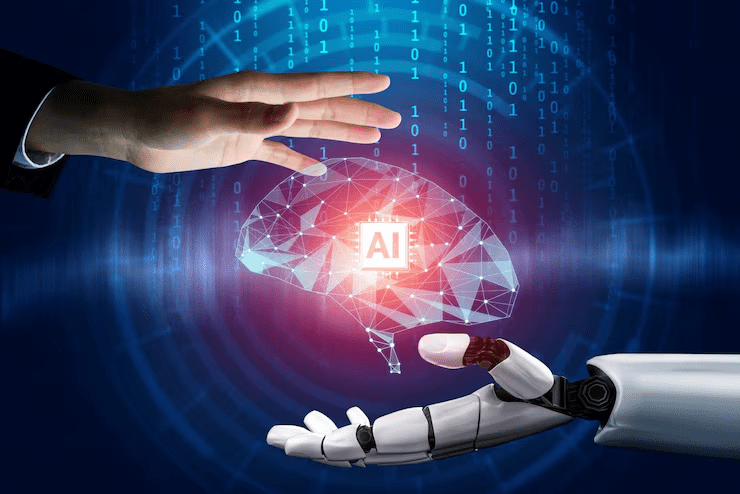
Artificial intelligence and machine learning are required by individuals, businesses, and industries that want to enhance decision-making, automate tasks, improve efficiency, and gain a competitive advantage through data.
🏢 1. Businesses and Organizations
✅ Why they need AI/ML:
- To automate repetitive tasks
- To understand customer behavior
- To forecast sales and demand
- To improve product recommendations
- To detect fraud and risks
🏭 Industries:
| Industry | Use of AI/ML |
|---|---|
| Retail | Personalized shopping, chatbots, inventory management |
| Healthcare | Disease prediction, diagnostics, treatment planning |
| Finance | Credit scoring, fraud detection, algorithmic trading |
| Manufacturing | Predictive maintenance, quality control |
| Marketing | Customer segmentation, targeted ads |
| Logistics | Route optimization, demand forecasting |
| Education | Smart tutoring, adaptive learning platforms |
| Entertainment | Content recommendations (e.g., Netflix, YouTube) |
🧑💻 2. Professionals & Developers
✅ Who:
- Data Scientists
- AI Engineers
- Software Developers
- Business Analysts
- Cybersecurity Experts
✅ Why they need it:
- To build smart applications
- To develop AI-based services
- To analyze and interpret large data sets
🎓 3. Students and Researchers
✅ Why they need AI/ML:
- To study automation, data science, and robotics
- To conduct academic research in intelligent systems
- To prepare for future tech-driven careers
🌍 4. Governments and Smart Cities
✅ Why:
- To enhance public services using smart systems (e.g., traffic, surveillance)
- To improve public safety and health management
- To make data-driven policy decisions
🛍️ 5. Consumers (Indirect Users)
✅ How they benefit:
- Smarter digital assistants (like Siri and Google Assistant)
- Personalized shopping and entertainment
- Faster, more accurate services (e.g., in banks, hospitals, transport)
✅ Summary
| Who Needs AI/ML | Why |
|---|---|
| Businesses & Industries | Automation, insights, growth, efficiency |
| Developers & Tech Experts | To create intelligent systems and apps |
| Students & Academics | To learn and innovate with modern technologies |
| Governments & Institutions | Public safety, governance, infrastructure |
| General Consumers | Enhanced services, recommendations, personal assistants |
When is Required Artificial Intelligence (AI) & Machine Learning?
Artificial Intelligence and Machine Learning are required whenever there is a need for automation, intelligent decision-making, or data-driven insights—especially in scenarios involving large volumes of data, repetitive tasks, or personalization.
✅ Key Situations When AI/ML is Required
🧠 1. When You Need to Make Smart Decisions from Big Data
- When: You have massive data from users, sensors, websites, etc.
- Why: Humans can’t analyze big data fast or accurately; ML finds patterns and insights.
- Example: Predicting customer churn or product demand.
🔄 2. When Repetitive Tasks Should Be Automated
- When: Tasks are time-consuming, rule-based, and repeated frequently.
- Why: AI/ML can automate these tasks, saving time and reducing errors.
- Example: Invoice processing, chatbot responses, sorting emails.
🛒 3. When You Want Personalized Experiences
- When: Users expect content, services, or recommendations tailored to them.
- Why: ML models learn individual preferences to deliver customized results.
- Example: Netflix movie recommendations, Amazon product suggestions.
🔍 4. When Prediction Is Critical
- When: You must forecast outcomes or behaviors based on trends and history.
- Why: ML can accurately predict risks, prices, sales, or failures.
- Example: Stock market forecasting, weather prediction, disease outbreak modeling.
🧩 5. When Human Decision-Making Is Too Slow or Complex
- When: You need fast, accurate decisions in real-time (sometimes life-critical).
- Why: AI can analyze and react faster than humans.
- Example: Self-driving cars, fraud detection in banking, real-time medical diagnosis.
🌐 6. When Scaling Operations Globally
- When: Businesses grow and manage users, inventory, or customer service across countries.
- Why: AI helps scale systems without hiring large teams.
- Example: 24/7 global customer service using AI chatbots.
📌 Summary Table
| Situation | When AI/ML is Required |
|---|---|
| Handling Big Data | To extract insights humans can’t see |
| Automating Repetitive Work | To reduce cost, time, and errors |
| Personalizing User Experience | To improve satisfaction and retention |
| Predicting Future Trends | To stay ahead in decision-making |
| Speeding Up Complex Decisions | When human processing is too slow or error-prone |
| Scaling with Efficiency | To manage global demand, users, and services |
Where is required artificial intelligence (AI) & machine learning?
Courtesy: HubSpot Marketing
Artificial Intelligence and Machine Learning are required in nearly every sector and environment—wherever there is data, decision-making, automation, personalization, or efficiency improvement. Below is a breakdown of where AI/ML is most used and required.
🏢 1. Business and Corporate Sector
Where:
- Offices
- Enterprises (large and small)
- Customer support centers
Use:
- Automating workflows
- Analyzing business data
- Personalizing customer experiences
- Fraud detection (in banks, e-commerce)
🏥 2. Healthcare
Where:
- Hospitals
- Diagnostic labs
- Health tech apps
Use:
- Predicting disease risks
- Medical imaging diagnostics
- Virtual health assistants
- Robot-assisted surgeries
🏭 3. Manufacturing & Industry
Where:
- Factories
- Supply chain systems
- Production plants
Use:
- Predictive maintenance
- Quality control with computer vision
- Process automation
- Inventory management
🏦 4. Banking & Finance
Where:
- Banks
- Financial institutions
- Fintech platforms
Use:
- Credit scoring
- Fraud detection
- Algorithmic trading
- Chatbots for customer queries
📱 5. Consumer Technology
Where:
- Mobile apps
- Smart home devices
- Streaming platforms
Use:
- Voice assistants (Alexa, Siri)
- Personalized recommendations (Netflix, YouTube)
- Smart home automation
- Face recognition (phone unlocking)
🚗 6. Transportation
Where:
- Logistics companies
- Self-driving vehicles
- Ride-sharing platforms
Use:
- Route optimization
- Traffic prediction
- Autonomous vehicles
- Drone deliveries
🛍️ 7. Retail & E-Commerce
Where:
- Online marketplaces
- Physical stores
- Warehouses
Use:
- Product recommendation engines
- Inventory forecasting
- Dynamic pricing
- Virtual shopping assistants
🎓 8. Education
Where:
- Online learning platforms
- Smart classrooms
Use:
- Adaptive learning systems
- Plagiarism detection
- Student performance prediction
🏛️ 9. Government and Public Services
Where:
- Smart cities
- Border security
- Public safety systems
Use:
- Surveillance and facial recognition
- Disaster response prediction
- Traffic and waste management
🎮 10. Gaming and Entertainment
Where:
- Game development studios
- Streaming services
Use:
- NPC behavior in games
- Personalized content delivery
- Deepfake and content creation tools
⚙️ How Is Artificial Intelligence (AI) & Machine Learning (ML) Required?
Artificial Intelligence and Machine Learning are required through a structured process involving problem identification, data collection, model development, deployment, and continuous learning. Here’s a detailed breakdown of how AI/ML is implemented and required in practice:
🔍 1. Problem Identification
How AI/ML is needed:
- Identify a business or technical problem that can be solved using data and prediction.
Examples:
- “How can we reduce customer churn?”
- “Can we predict machine failure before it happens?”
📊 2. Data Collection & Preparation
How it’s required:
- Gather structured or unstructured data from databases, sensors, customer records, etc.
- Clean and preprocess the data (remove errors, fill missing values).
Examples:
- Use Excel, SQL, or data scraping tools.
- Convert raw data into a machine-readable format.
🧠 3. Model Building (AI/ML Development)
How it’s required:
- Use ML algorithms (e.g., regression, decision trees, neural networks) to train a model on historical data.
- AI systems (like chatbots or vision systems) are created using trained models.
Tools Used:
- Python (Scikit-learn, TensorFlow, PyTorch)
- R, MATLAB, Jupyter Notebooks
🧪 4. Model Testing & Evaluation
How it’s required:
- Validate the model’s accuracy using testing data.
- Use metrics like accuracy, precision, recall, and F1-score.
Goal:
- Ensure that predictions or classifications are reliable before deployment.
🚀 5. Deployment & Integration
How it’s required:
- Integrate AI/ML into software systems, apps, websites, or devices.
- Deploy in cloud environments like AWS, Azure, or Google Cloud.
Examples:
- Chatbot on a website
- Fraud detection engine in a banking app
🔄 6. Monitoring & Continuous Learning
How it’s required:
- Continuously monitor the system’s performance.
- Update the models with new data (called “retraining”).
Why:
- AI models degrade over time if not updated (this is called “model drift”).
📌 Step-by-Step Summary Table
| Step | How AI/ML Is Required |
|---|---|
| 1. Identify the problem | Decide what needs to be predicted, automated, or improved |
| 2. Collect & prepare data | Gather and clean data relevant to the task |
| 3. Develop ML model | Use algorithms to train models that learn from data |
| 4. Evaluate & validate | Test accuracy, reduce errors, and prevent bias |
| 5. Deploy into production | Integrate into apps, websites, or machines |
| 6. Monitor & update | Keep improving performance with new data and feedback |
🔧 Tools & Platforms Commonly Used
| Area | Tools / Languages |
|---|---|
| Programming | Python, R, Java, C++ |
| Libraries | TensorFlow, PyTorch, Scikit-learn |
| Data Analysis | Pandas, NumPy, Excel, SQL |
| Deployment | Docker, Flask, AWS, Google Cloud |
| Visualization | Power BI, Tableau, Matplotlib, Seaborn |
Case Study on artificial intelligence (AI) & machine learning?
📘 Case Study: Predictive Maintenance in Manufacturing Using AI & ML
✅ Industry: Manufacturing (Automobile)
🏭 Company: General Motors (GM)
🔍 Problem: Unexpected Equipment Failures
General Motors was facing high costs and production delays due to:
- Sudden machine breakdowns on assembly lines
- Maintenance based only on fixed schedules (whether needed or not)
- Downtime causing missed deadlines and product waste
🎯 Objective:
Implement a predictive maintenance system using AI/ML to:
- Predict equipment failures before they happen
- Optimize maintenance schedules
- Reduce operational downtime and cost
🔧 Solution: AI & Machine Learning Deployment
🛠️ Tools & Technologies Used:
- Sensors on machines (IoT)
- Cloud storage for real-time data
- Python & ML algorithms for predictive modeling
- AI platform: Microsoft Azure Machine Learning
📊 Step-by-Step Implementation:
| Step | Activity |
|---|---|
| 1. Data Collection | Installed sensors on machines to collect temperature, pressure, vibration, usage hours |
| 2. Data Cleaning | Removed noise, missing values, and formatted time series data |
| 3. Model Training | Trained ML algorithms (Random Forest, Logistic Regression) to predict failure patterns |
| 4. Prediction | AI alerts maintenance teams when a part shows signs of wear or failure risk |
| 5. Dashboarding | Real-time dashboards help engineers visualize machine health |
✅ Results After 6 Months:
| Metric | Before AI | After AI Implementation |
|---|---|---|
| Unplanned Downtime | High | Reduced by 30% |
| Maintenance Cost | High | Reduced by 20% |
| Production Output | Delayed | Improved by 15% |
| Equipment Lifetime | Standard | Increased by 25% |
💡 Key Learnings:
- AI/ML helped shift from reactive to predictive maintenance.
- Real-time data and intelligent algorithms improved operational efficiency.
- The company achieved cost savings and higher productivity.
- Maintenance staff were trained to respond only when alerts were raised, reducing unnecessary labor.
🔚 Conclusion:
This case study shows that AI & ML are not just technical innovations—they are strategic tools to solve real problems. With proper data, tools, and training, even traditional industries like automotive manufacturing can digitally transform and gain a competitive edge.
White paper on Artificial Intelligence (AI) & Machine Learning?
📌 Executive Summary
Artificial Intelligence (AI) and Machine Learning (ML) are transforming every sector of the global economy—from healthcare and finance to transportation and manufacturing. This white paper provides an in-depth overview of AI and ML, explores their applications, benefits, challenges, and outlines best practices for successful implementation across industries.
1. 🎯 Introduction
Artificial Intelligence refers to computer systems that simulate human intelligence. Machine Learning, a subset of AI, enables machines to learn from data and improve over time without being explicitly programmed.
Together, AI and ML are powering innovations in automation, prediction, personalization, and decision-making.
2. 🔍 What is AI & ML?
| Term | Definition |
|---|---|
| Artificial Intelligence | Technology enabling machines to mimic human cognitive functions like reasoning, learning, and problem-solving. |
| Machine Learning | An AI technique that allows systems to learn from data to make decisions or predictions. |
Types of Machine Learning:
- Supervised Learning: Learns from labeled data (e.g., fraud detection)
- Unsupervised Learning: Finds patterns in unlabeled data (e.g., customer segmentation)
- Reinforcement Learning: Learns through trial and error (e.g., robotics, gaming)
3. 🌐 Global Applications
| Industry | Use Case Example |
|---|---|
| Healthcare | Disease prediction, medical imaging, drug discovery |
| Finance | Credit scoring, fraud detection, algorithmic trading |
| Retail | Recommendation engines, demand forecasting |
| Manufacturing | Predictive maintenance, process automation |
| Transportation | Autonomous vehicles, route optimization |
4. ⚙️ AI/ML Development Lifecycle
- Define the Problem
- Data Collection & Preprocessing
- Model Development (Training)
- Testing & Evaluation
- Deployment
- Monitoring & Maintenance
5. ✅ Benefits of AI & ML
- 📉 Cost Reduction: Automation of routine tasks
- ⏱️ Faster Decision-Making: Real-time data insights
- 🧠 Increased Accuracy: Error reduction and better forecasting
- 💡 Innovation: New product development and personalization
6. ⚠️ Challenges
| Challenge | Description |
|---|---|
| Data Privacy | Protecting sensitive user data |
| Bias in AI Models | Algorithms reflecting societal or training bias |
| High Skill Requirement | Need for data scientists and engineers |
| Explainability | Understanding how AI systems make decisions |
7. 🏭 Industrial Adoption Case Study
Company: Siemens
Use Case: Predictive maintenance using ML on factory equipment
Outcome: Reduced machine downtime by 40%, improved operational efficiency, and saved millions in maintenance costs.
8. 📈 Future Outlook
- 🌍 AI will contribute $15.7 trillion to the global economy by 2030 (PwC).
- Emphasis will grow on ethical AI, low-code tools, and edge AI.
- AI & ML will evolve to be more accessible, integrated into everyday software.
9. 🛠️ Best Practices for Implementation
- Start with a pilot project and clear ROI goals.
- Use high-quality, diverse datasets.
- Involve cross-functional teams (IT, business, compliance).
- Choose scalable AI platforms (e.g., Azure, AWS, Google Cloud).
- Continuously monitor and improve models.
📚 References
- Stanford University AI Index Report
- McKinsey & Company: The State of AI in 2024
- PwC: AI’s Impact on the Global Economy
- World Economic Forum Reports on AI Governance
📎 Appendix
- Glossary of AI Terms
- Sample Code for ML in Python
- AI Compliance Checklist (GDPR, CCPA)
Industrial Application of Artificial Intelligence (AI) & Machine Learning?
Courtesy: IBM Technology
🏭 Industrial Applications of AI & ML
AI and ML technologies are revolutionizing industries by automating complex tasks, improving decision-making, and enabling intelligent data-driven solutions. Here’s how they are applied across various sectors:
1. Manufacturing
Applications:
- Predictive Maintenance: ML models analyze sensor data to predict equipment failure before it occurs, reducing downtime.
- Quality Inspection: Computer vision systems identify defects in real-time during production.
- Supply Chain Optimization: AI predicts demand, manages inventory, and reduces waste.
- Process Automation: Robotics and AI control production lines for better speed and precision.
Example: Siemens uses AI for smart factories to optimize performance and reduce machine failure.
2. Healthcare
Applications:
- Medical Imaging: AI detects diseases such as cancer or fractures in X-rays and MRIs.
- Patient Risk Scoring: ML predicts patients at risk of chronic diseases using EHR data.
- Drug Discovery: AI accelerates research by identifying potential compounds quickly.
- Virtual Assistants: AI chatbots help in appointment scheduling and patient communication.
Example: IBM Watson Health has been used in oncology for cancer diagnosis assistance.
3. Finance & Banking
Applications:
- Fraud Detection: AI monitors transactions in real-time to flag anomalies.
- Credit Scoring: ML assesses borrowers’ risk using alternative data sources.
- Algorithmic Trading: AI makes rapid trading decisions based on market data.
- Chatbots & Customer Service: Virtual agents resolve queries and reduce human workload.
Example: JPMorgan Chase uses AI to analyze legal documents and reduce time spent on paperwork.
4. Retail & E-Commerce
Applications:
- Recommendation Engines: ML suggests products to users based on their behavior.
- Customer Behavior Analysis: AI predicts trends, preferences, and churn risk.
- Inventory Management: Forecasts demand and manages stock levels efficiently.
- Visual Search & Chatbots: Customers can search products using images and get support via AI bots.
Example: Amazon’s recommendation engine drives a significant portion of its sales using ML.
5. Transportation & Logistics
Applications:
- Autonomous Vehicles: AI enables self-driving cars and trucks.
- Fleet Management: AI monitors vehicle health, routes, and driver behavior.
- Route Optimization: ML minimizes delivery times and fuel usage.
- Warehouse Automation: Robots and AI manage sorting, packing, and inventory.
Example: UPS uses AI algorithms to determine optimal delivery routes, saving millions in fuel.
6. Agriculture
Applications:
- Precision Farming: AI recommends the best planting strategies using satellite data.
- Crop Disease Detection: ML identifies early signs of disease in plants.
- Yield Prediction: AI estimates crop output based on environmental data.
Example: John Deere integrates AI into farming equipment for real-time soil analysis.
7. Energy & Utilities
Applications:
- Smart Grids: AI forecasts energy demand and manages distribution.
- Fault Detection: ML detects irregularities in power lines or pipelines.
- Renewable Energy Management: AI predicts weather and adjusts solar/wind usage.
Example: Google DeepMind helped reduce energy use for cooling in Google data centers by 40%.
8. Telecommunications
Applications:
- Network Optimization: AI dynamically manages bandwidth and network load.
- Customer Retention: ML models predict churn and recommend retention strategies.
- Fraud Prevention: AI detects unusual usage patterns and threats.
Example: AT&T uses AI to manage and predict network traffic for improved performance.
🚀 Summary Table
| Industry | Key AI/ML Use Cases |
|---|---|
| Manufacturing | Predictive maintenance, quality inspection |
| Healthcare | Diagnostics, drug discovery, patient monitoring |
| Finance | Fraud detection, credit scoring, algorithmic trading |
| Retail | Product recommendations, inventory optimization |
| Logistics | Route optimization, warehouse automation |
| Agriculture | Precision farming, crop disease prediction |
| Energy | Smart grids, energy forecasting, fault detection |
| Telecom | Network optimization, customer analytics |
💡 Conclusion
AI and ML are not just buzzwords—they are critical technologies that are driving innovation, efficiency, and transformation across all major industries. Organizations that strategically adopt these technologies are better positioned for scalability and competitive advantage.
References
- ^ Jump up to:a b c Russell & Norvig (2021), pp. 1–4.
- ^ AI set to exceed human brain power Archived 2008-02-19 at the Wayback Machine CNN.com (July 26, 2006)
- ^ Kaplan, Andreas; Haenlein, Michael (2019). “Siri, Siri, in my hand: Who’s the fairest in the land? On the interpretations, illustrations, and implications of artificial intelligence”. Business Horizons. 62: 15–25. doi:10.1016/j.bushor.2018.08.004. ISSN 0007-6813. S2CID 158433736.
- ^ Russell & Norvig (2021, §1.2).
- ^ “Tech companies want to build artificial general intelligence. But who decides when AGI is attained?”. AP News. 4 April 2024. Retrieved 20 May 2025.
- ^ Jump up to:a b Dartmouth workshop: Russell & Norvig (2021, p. 18), McCorduck (2004, pp. 111–136), NRC (1999, pp. 200–201)
The proposal: McCarthy et al. (1955) - ^ Jump up to:a b Successful programs of the 1960s: McCorduck (2004, pp. 243–252), Crevier (1993, pp. 52–107), Moravec (1988, p. 9), Russell & Norvig (2021, pp. 19–21)
- ^ Jump up to:a b Funding initiatives in the early 1980s: Fifth Generation Project (Japan), Alvey (UK), Microelectronics and Computer Technology Corporation (US), Strategic Computing Initiative (US): McCorduck (2004, pp. 426–441), Crevier (1993, pp. 161–162, 197–203, 211, 240), Russell & Norvig (2021, p. 23), NRC (1999, pp. 210–211), Newquist (1994, pp. 235–248)
- ^ Jump up to:a b First AI Winter, Lighthill report, Mansfield Amendment: Crevier (1993, pp. 115–117), Russell & Norvig (2021, pp. 21–22), NRC (1999, pp. 212–213), Howe (1994), Newquist (1994, pp. 189–201)
- ^ Jump up to:a b Second AI Winter: Russell & Norvig (2021, p. 24), McCorduck (2004, pp. 430–435), Crevier (1993, pp. 209–210), NRC (1999, pp. 214–216), Newquist (1994, pp. 301–318)
- ^ Jump up to:a b Deep learning revolution, AlexNet: Goldman (2022), Russell & Norvig (2021, p. 26), McKinsey (2018)
- ^ Toews (2023).
- ^ Problem-solving, puzzle solving, game playing, and deduction: Russell & Norvig (2021, chpt. 3–5), Russell & Norvig (2021, chpt. 6) (constraint satisfaction), Poole, Mackworth & Goebel (1998, chpt. 2, 3, 7, 9), Luger & Stubblefield (2004, chpt. 3, 4, 6, 8), Nilsson (1998, chpt. 7–12)
- ^ Uncertain reasoning: Russell & Norvig (2021, chpt. 12–18), Poole, Mackworth & Goebel (1998, pp. 345–395), Luger & Stubblefield (2004, pp. 333–381), Nilsson (1998, chpt. 7–12)
- ^ Jump up to:a b c Intractability and efficiency and the combinatorial explosion: Russell & Norvig (2021, p. 21)
- ^ Jump up to:a b c Psychological evidence of the prevalence of sub-symbolic reasoning and knowledge: Kahneman (2011), Dreyfus & Dreyfus (1986), Wason & Shapiro (1966), Kahneman, Slovic & Tversky (1982)
- ^ Knowledge representation and knowledge engineering: Russell & Norvig (2021, chpt. 10), Poole, Mackworth & Goebel (1998, pp. 23–46, 69–81, 169–233, 235–277, 281–298, 319–345), Luger & Stubblefield (2004, pp. 227–243), Nilsson (1998, chpt. 17.1–17.4, 18)
- ^ Smoliar & Zhang (1994).
- ^ Neumann & Möller (2008).
- ^ Kuperman, Reichley & Bailey (2006).
- ^ McGarry (2005).
- ^ Bertini, Del Bimbo & Torniai (2006).
- ^ Russell & Norvig (2021), pp. 272.
- ^ Representing categories and relations: Semantic networks, description logics, inheritance (including frames, and scripts): Russell & Norvig (2021, §10.2 & 10.5), Poole, Mackworth & Goebel (1998, pp. 174–177), Luger & Stubblefield (2004, pp. 248–258), Nilsson (1998, chpt. 18.3)
- ^ Representing events and time:Situation calculus, event calculus, fluent calculus (including solving the frame problem): Russell & Norvig (2021, §10.3), Poole, Mackworth & Goebel (1998, pp. 281–298), Nilsson (1998, chpt. 18.2)
- ^ Causal calculus: Poole, Mackworth & Goebel (1998, pp. 335–337)
- ^ Representing knowledge about knowledge: Belief calculus, modal logics: Russell & Norvig (2021, §10.4), Poole, Mackworth & Goebel (1998, pp. 275–277)
- ^ Jump up to:a b Default reasoning, Frame problem, default logic, non-monotonic logics, circumscription, closed world assumption, abduction: Russell & Norvig (2021, §10.6), Poole, Mackworth & Goebel (1998, pp. 248–256, 323–335), Luger & Stubblefield (2004, pp. 335–363), Nilsson (1998, ~18.3.3) (Poole et al. places abduction under “default reasoning”. Luger et al. places this under “uncertain reasoning”).
- ^ Jump up to:a b Breadth of commonsense knowledge: Lenat & Guha (1989, Introduction), Crevier (1993, pp. 113–114), Moravec (1988, p. 13), Russell & Norvig (2021, pp. 241, 385, 982) (qualification problem)
- ^ Newquist (1994), p. 296.
- ^ Crevier (1993), pp. 204–208.
- ^ Russell & Norvig (2021), p. 528.
- ^ Automated planning: Russell & Norvig (2021, chpt. 11).
- ^ Automated decision making, Decision theory: Russell & Norvig (2021, chpt. 16–18).
- ^ Classical planning: Russell & Norvig (2021, Section 11.2).
- ^ Sensorless or “conformant” planning, contingent planning, replanning (a.k.a. online planning): Russell & Norvig (2021, Section 11.5).
- ^ Uncertain preferences: Russell & Norvig (2021, Section 16.7) Inverse reinforcement learning: Russell & Norvig (2021, Section 22.6)
- ^ Information value theory: Russell & Norvig (2021, Section 16.6).
- ^ Markov decision process: Russell & Norvig (2021, chpt. 17).
- ^ Game theory and multi-agent decision theory: Russell & Norvig (2021, chpt. 18).
- ^ Learning: Russell & Norvig (2021, chpt. 19–22), Poole, Mackworth & Goebel (1998, pp. 397–438), Luger & Stubblefield (2004, pp. 385–542), Nilsson (1998, chpt. 3.3, 10.3, 17.5, 20)
- ^ Turing (1950).
- ^ Solomonoff (1956).
- ^ Unsupervised learning: Russell & Norvig (2021, pp. 653) (definition), Russell & Norvig (2021, pp. 738–740) (cluster analysis), Russell & Norvig (2021, pp. 846–860) (word embedding)
- ^ Jump up to:a b Supervised learning: Russell & Norvig (2021, §19.2) (Definition), Russell & Norvig (2021, Chpt. 19–20) (Techniques)
- ^ Reinforcement learning: Russell & Norvig (2021, chpt. 22), Luger & Stubblefield (2004, pp. 442–449)
- ^ Transfer learning: Russell & Norvig (2021, pp. 281), The Economist (2016)
- ^ “Artificial Intelligence (AI): What Is AI and How Does It Work? | Built In”. builtin.com. Retrieved 30 October 2023.
- ^ Computational learning theory: Russell & Norvig (2021, pp. 672–674), Jordan & Mitchell (2015)
- ^ Natural language processing (NLP): Russell & Norvig (2021, chpt. 23–24), Poole, Mackworth & Goebel (1998, pp. 91–104), Luger & Stubblefield (2004, pp. 591–632)
- ^ Subproblems of NLP: Russell & Norvig (2021, pp. 849–850)
- ^ Russell & Norvig (2021), pp. 856–858.
- ^ Dickson (2022).
- ^ Modern statistical and deep learning approaches to NLP: Russell & Norvig (2021, chpt. 24), Cambria & White (2014)
- ^ Vincent (2019).
- ^ Russell & Norvig (2021), pp. 875–878.
- ^ Bushwick (2023).
- ^ Computer vision: Russell & Norvig (2021, chpt. 25), Nilsson (1998, chpt. 6)
- ^ Russell & Norvig (2021), pp. 849–850.
- ^ Russell & Norvig (2021), pp. 895–899.
- ^ Russell & Norvig (2021), pp. 899–901.
- ^ Challa et al. (2011).
- ^ Russell & Norvig (2021), pp. 931–938.
- ^ MIT AIL (2014).
- ^ Affective computing: Thro (1993), Edelson (1991), Tao & Tan (2005), Scassellati (2002)
- ^ Waddell (2018).
- ^ Poria et al. (2017).
- ^ Jump up to:a b Artificial general intelligence: Russell & Norvig (2021, pp. 32–33, 1020–1021)
Proposal for the modern version: Pennachin & Goertzel (2007)
Warnings of overspecialization in AI from leading researchers: Nilsson (1995), McCarthy (2007), Beal & Winston (2009) - ^ Search algorithms: Russell & Norvig (2021, chpts. 3–5), Poole, Mackworth & Goebel (1998, pp. 113–163), Luger & Stubblefield (2004, pp. 79–164, 193–219), Nilsson (1998, chpts. 7–12)
- ^ State space search: Russell & Norvig (2021, chpt. 3)
- ^ Russell & Norvig (2021), sect. 11.2.
- ^ Uninformed searches (breadth first search, depth-first search and general state space search): Russell & Norvig (2021, sect. 3.4), Poole, Mackworth & Goebel (1998, pp. 113–132), Luger & Stubblefield (2004, pp. 79–121), Nilsson (1998, chpt. 8)
- ^ Heuristic or informed searches (e.g., greedy best first and A*): Russell & Norvig (2021, sect. 3.5), Poole, Mackworth & Goebel (1998, pp. 132–147), Poole & Mackworth (2017, sect. 3.6), Luger & Stubblefield (2004, pp. 133–150)
- ^ Adversarial search: Russell & Norvig (2021, chpt. 5)
- ^ Local or “optimization” search: Russell & Norvig (2021, chpt. 4)
- ^ Singh Chauhan, Nagesh (18 December 2020). “Optimization Algorithms in Neural Networks”. KDnuggets. Retrieved 13 January 2024.
- ^ Evolutionary computation: Russell & Norvig (2021, sect. 4.1.2)
- ^ Merkle & Middendorf (2013).
- ^ Logic: Russell & Norvig (2021, chpts. 6–9), Luger & Stubblefield (2004, pp. 35–77), Nilsson (1998, chpt. 13–16)
- ^ Propositional logic: Russell & Norvig (2021, chpt. 6), Luger & Stubblefield (2004, pp. 45–50), Nilsson (1998, chpt. 13)
- ^ First-order logic and features such as equality: Russell & Norvig (2021, chpt. 7), Poole, Mackworth & Goebel (1998, pp. 268–275), Luger & Stubblefield (2004, pp. 50–62), Nilsson (1998, chpt. 15)
- ^ Logical inference: Russell & Norvig (2021, chpt. 10)
- ^ logical deduction as search: Russell & Norvig (2021, sects. 9.3, 9.4), Poole, Mackworth & Goebel (1998, pp. ~46–52), Luger & Stubblefield (2004, pp. 62–73), Nilsson (1998, chpt. 4.2, 7.2)
- ^ Resolution and unification: Russell & Norvig (2021, sections 7.5.2, 9.2, 9.5)
- ^ Warren, D.H.; Pereira, L.M.; Pereira, F. (1977). “Prolog-the language and its implementation compared with Lisp”. ACM SIGPLAN Notices. 12 (8): 109–115. doi:10.1145/872734.806939.
- ^ Fuzzy logic: Russell & Norvig (2021, pp. 214, 255, 459), Scientific American (1999)
- ^ Jump up to:a b Stochastic methods for uncertain reasoning: Russell & Norvig (2021, chpt. 12–18, 20), Poole, Mackworth & Goebel (1998, pp. 345–395), Luger & Stubblefield (2004, pp. 165–191, 333–381), Nilsson (1998, chpt. 19)
- ^ decision theory and decision analysis: Russell & Norvig (2021, chpt. 16–18), Poole, Mackworth & Goebel (1998, pp. 381–394)
- ^ Information value theory: Russell & Norvig (2021, sect. 16.6)
- ^ Markov decision processes and dynamic decision networks: Russell & Norvig (2021, chpt. 17)
- ^ Jump up to:a b c Stochastic temporal models: Russell & Norvig (2021, chpt. 14) Hidden Markov model: Russell & Norvig (2021, sect. 14.3) Kalman filters: Russell & Norvig (2021, sect. 14.4) Dynamic Bayesian networks: Russell & Norvig (2021, sect. 14.5)
- ^ Game theory and mechanism design: Russell & Norvig (2021, chpt. 18)
- ^ Bayesian networks: Russell & Norvig (2021, sects. 12.5–12.6, 13.4–13.5, 14.3–14.5, 16.5, 20.2–20.3), Poole, Mackworth & Goebel (1998, pp. 361–381), Luger & Stubblefield (2004, pp. ~182–190, ≈363–379), Nilsson (1998, chpt. 19.3–19.4)
- ^ Domingos (2015), chpt. 6.
- ^ Bayesian inference algorithm: Russell & Norvig (2021, sect. 13.3–13.5), Poole, Mackworth & Goebel (1998, pp. 361–381), Luger & Stubblefield (2004, pp. ~363–379), Nilsson (1998, chpt. 19.4 & 7)
- ^ Domingos (2015), p. 210.
- ^ Bayesian learning and the expectation–maximization algorithm: Russell & Norvig (2021, chpt. 20), Poole, Mackworth & Goebel (1998, pp. 424–433), Nilsson (1998, chpt. 20), Domingos (2015, p. 210)
- ^ Bayesian decision theory and Bayesian decision networks: Russell & Norvig (2021, sect. 16.5)
- ^ Statistical learning methods and classifiers: Russell & Norvig (2021, chpt. 20),
- ^ Ciaramella, Alberto; Ciaramella, Marco (2024). Introduction to Artificial Intelligence: from data analysis to generative AI. Intellisemantic Editions. ISBN 978-8-8947-8760-3.
- ^ Decision trees: Russell & Norvig (2021, sect. 19.3), Domingos (2015, p. 88)
- ^Non-parameteric learning models such as K-nearest neighbor and support vector machines: Russell & Norvig (2021, sect. 19.7), Domingos (2015, p. 187) (k-nearest neighbor)
- Domingos (2015, p. 88) (kernel methods)
- ^ Domingos (2015), p. 152.
- ^ Naive Bayes classifier: Russell & Norvig (2021, sect. 12.6), Domingos (2015, p. 152)
- ^ Jump up to:a b Neural networks: Russell & Norvig (2021, chpt. 21), Domingos (2015, Chapter 4)
- ^ Gradient calculation in computational graphs, backpropagation, automatic differentiation: Russell & Norvig (2021, sect. 21.2), Luger & Stubblefield (2004, pp. 467–474), Nilsson (1998, chpt. 3.3)
- ^ Universal approximation theorem: Russell & Norvig (2021, p. 752) The theorem: Cybenko (1988), Hornik, Stinchcombe & White (1989)
- ^ Feedforward neural networks: Russell & Norvig (2021, sect. 21.1)
- ^ Recurrent neural networks: Russell & Norvig (2021, sect. 21.6)
- ^ Perceptrons: Russell & Norvig (2021, pp. 21, 22, 683, 22)
- ^ Jump up to:a b Deep learning: Russell & Norvig (2021, chpt. 21), Goodfellow, Bengio & Courville (2016), Hinton et al. (2016), Schmidhuber (2015)
- ^ Convolutional neural networks: Russell & Norvig (2021, sect. 21.3)
- ^ Deng & Yu (2014), pp. 199–200.
- ^ Ciresan, Meier & Schmidhuber (2012).
- ^ Russell & Norvig (2021), p. 750.
- ^ Jump up to:a b c Russell & Norvig (2021), p. 17.
- ^ Jump up to:a b c d e f g Russell & Norvig (2021), p. 785.
- ^ Jump up to:a b Schmidhuber (2022), sect. 5.
- ^ Schmidhuber (2022), sect. 6.
- ^ Jump up to:a b c Schmidhuber (2022), sect. 7.
- ^ Schmidhuber (2022), sect. 8.
- ^ Quoted in Christian (2020, p. 22)
- ^ Metz, Cade; Weise, Karen (5 May 2025). “A.I. Hallucinations Are Getting Worse, Even as New Systems Become More Powerful”. The New York Times. ISSN 0362-4331. Retrieved 6 May 2025.
- ^ Smith (2023).
- ^ “Explained: Generative AI”. 9 November 2023.
- ^ “AI Writing and Content Creation Tools”. MIT Sloan Teaching & Learning Technologies. Archived from the original on 25 December 2023. Retrieved 25 December 2023.
- ^ Marmouyet (2023).
- ^ Kobielus (2019).
- ^ Thomason, James (21 May 2024). “Mojo Rising: The resurgence of AI-first programming languages”. VentureBeat. Archived from the original on 27 June 2024. Retrieved 26 May 2024.
- ^ Wodecki, Ben (5 May 2023). “7 AI Programming Languages You Need to Know”. AI Business. Archived from the original on 25 July 2024. Retrieved 5 October 2024.
- ^ Plumb, Taryn (18 September 2024). “Why Jensen Huang and Marc Benioff see ‘gigantic’ opportunity for agentic AI”. VentureBeat. Archived from the original on 5 October 2024. Retrieved 4 October 2024.
- ^ Mims, Christopher (19 September 2020). “Huang’s Law Is the New Moore’s Law, and Explains Why Nvidia Wants Arm”. Wall Street Journal. ISSN 0099-9660. Archived from the original on 2 October 2023. Retrieved 19 January 2025.
- ^ Davenport, T; Kalakota, R (June 2019). “The potential for artificial intelligence in healthcare”. Future Healthc J. 6 (2): 94–98. doi:10.7861/futurehosp.6-2-94. PMC 6616181. PMID 31363513.
- ^ Lyakhova, U.A.; Lyakhov, P.A. (2024). “Systematic review of approaches to detection and classification of skin cancer using artificial intelligence: Development and prospects”. Computers in Biology and Medicine. 178: 108742. doi:10.1016/j.compbiomed.2024.108742. PMID 38875908. Archived from the original on 3 December 2024. Retrieved 10 October 2024.
- ^ Alqudaihi, Kawther S.; Aslam, Nida; Khan, Irfan Ullah; Almuhaideb, Abdullah M.; Alsunaidi, Shikah J.; Ibrahim, Nehad M. Abdel Rahman; Alhaidari, Fahd A.; Shaikh, Fatema S.; Alsenbel, Yasmine M.; Alalharith, Dima M.; Alharthi, Hajar M.; Alghamdi, Wejdan M.; A