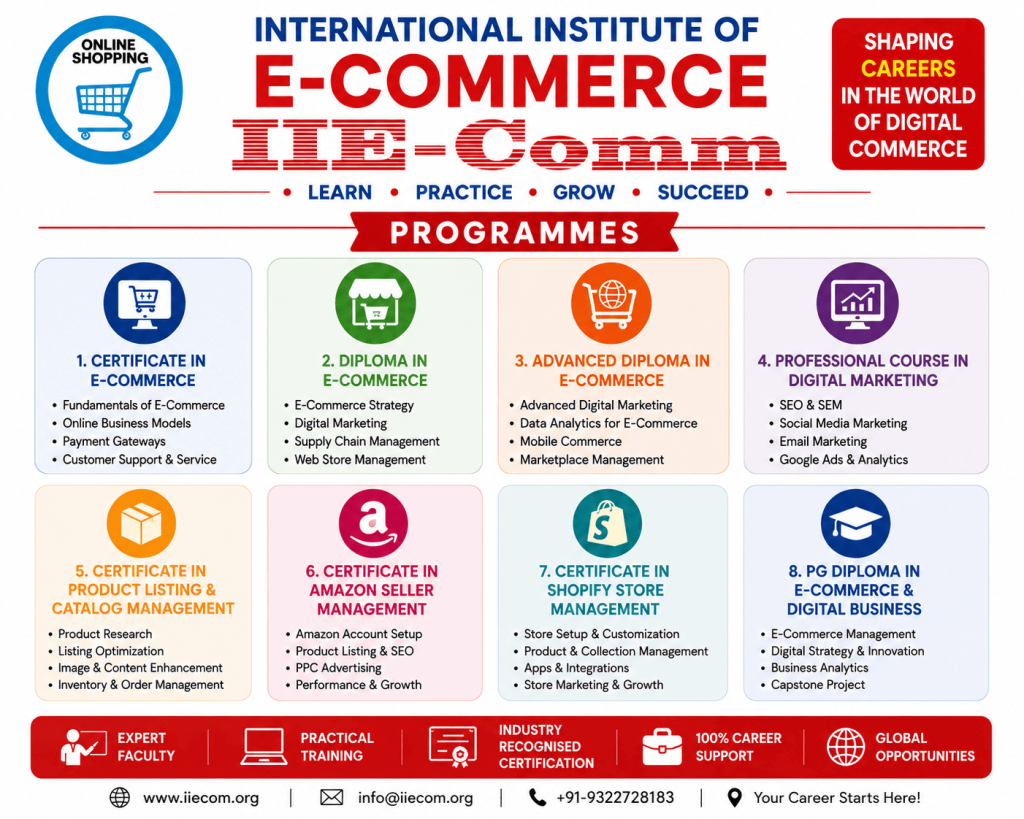
Programmes
- 1 Day Awareness Training Program IIE-COM Download
- 2 Days Advance Training on E-Commerce IIE-COM Download
- 4 Days Advance Course on E-commerce IIE-COM Download
- 7 Days E-Commerce Boot Stamp Camp IIE-COM Download
- 14 Days Practical E-Commerce Workshop IIE-COM Download
- 06 Month Diploma in E-Commerce IIE-COM Download
- 01 Year Post Graduate Diploma in E-Commerce IIE-COM Download
What is Required at the International Institute of E-Commerce IIECOM Programmes?
The International Institute of E-Commerce (IIECOM) offers programmes designed to provide learners with knowledge and practical skills in e-commerce, digital business, online marketing, entrepreneurship, and related fields. The requirements for admission may vary depending on the specific programme, level of study, and institutional policies. However, most IIECOM programmes generally require applicants to meet certain academic, technical, and personal criteria to ensure they can successfully complete their studies.
1. Educational Requirements
The primary requirement for admission into an IIECOM programme is an appropriate educational background. For introductory or certificate-level programmes, applicants may only need a basic secondary school qualification or equivalent. These programmes are often designed for beginners who want to develop foundational knowledge of online business, digital platforms, and e-commerce operations.
For advanced programmes, such as diplomas or professional certifications, applicants may be required to have completed higher secondary education, a university degree, or previous training in business, information technology, marketing, or related areas. Some programmes may also consider professional experience as an alternative qualification, especially for working professionals seeking to upgrade their skills.
2. Basic Computer and Internet Skills
Since e-commerce relies heavily on digital technologies, applicants are usually expected to have basic computer literacy. Students should be comfortable using computers, browsing the internet, communicating through digital platforms, and working with common software applications.
Knowledge of online tools such as email, word processing, spreadsheets, social media platforms, and online payment systems can be helpful. While advanced technical skills may not always be required, having a willingness to learn digital technologies is essential for success in an e-commerce programme.
3. Language Requirements
Most IIECOM programmes require students to have a reasonable understanding of the language used for instruction, commonly English. Applicants may need to demonstrate their ability to read, write, and communicate effectively in English, particularly for programmes involving international business, online communication, and digital marketing.
Strong communication skills are important because e-commerce professionals frequently interact with customers, businesses, suppliers, and global audiences through online channels.
4. Admission Documents
Applicants are generally required to submit supporting documents during the admission process. These may include:
- Completed application form
- Academic certificates or transcripts
- Proof of identity, such as a passport or national identification document
- Passport-sized photographs
- Proof of work experience (if required)
- Any additional documents requested by the institute
Applicants should ensure that all information provided is accurate and complete to avoid delays in admission processing.
5. Personal Qualities and Motivation
Apart from academic qualifications, successful e-commerce students should have an interest in technology, business development, and innovation. A willingness to adapt to changing digital trends, solve problems creatively, and learn new tools is important.
Entrepreneurial thinking, curiosity, communication ability, and self-discipline are valuable qualities for students pursuing e-commerce education. Since many programmes involve practical assignments and online projects, students should be prepared to manage their time effectively and participate actively in learning activities.
6. Financial and Technical Preparation
Students may also need to meet financial requirements, including payment of tuition fees and other programme-related costs. For online programmes, learners should have access to a reliable internet connection, a computer or suitable device, and the necessary software or digital tools required for coursework.
Who Is Required for International Institute of E-Commerce (IIECOM) Programmes?
The International Institute of E-Commerce (IIE-COM) programmes are designed for individuals who want to develop skills in e-commerce, digital marketing, online business management, and global digital trade. The programmes are suitable for a wide range of learners, including students, professionals, entrepreneurs, business owners, and anyone interested in building a career or business in the digital economy. IIE-COM focuses on preparing learners with practical knowledge and industry-relevant skills needed to succeed in the growing e-commerce sector.
1. Students and Fresh Graduates
Students and recent graduates are among the main groups who can benefit from IIECOM programmes. Young learners who want to enter the digital business world can gain knowledge about online stores, digital marketing, customer management, e-commerce platforms, and business strategies.
Graduates from fields such as business administration, marketing, information technology, commerce, and management can use these programmes to improve their career opportunities. The courses can help students develop practical skills that complement their academic qualifications and prepare them for roles in the e-commerce industry.
2. Working Professionals
Professionals who want to upgrade their skills or transition into the digital economy can also join IIECOM programmes. Many industries are adopting online business models, creating a demand for employees who understand digital sales, online marketing, e-commerce operations, and technology-based business solutions.
Employees working in marketing, sales, retail, business development, information technology, and management can use these programmes to improve their professional abilities and remain competitive in a changing job market. IIE-COM also provides career-focused learning opportunities that support professional growth.
3. Entrepreneurs and Business Owners
Business owners and entrepreneurs who want to establish or expand their online presence can benefit from IIECOM programmes. These courses are useful for individuals planning to start online businesses, sell products through marketplaces, or improve existing digital operations.
Entrepreneurs can learn about online store creation, digital marketing strategies, customer acquisition, payment systems, logistics, and international e-commerce opportunities. Such knowledge helps business owners make better decisions and compete effectively in online markets.
4. Freelancers and Digital Professionals
Freelancers, digital marketers, social media managers, and online service providers can also benefit from IIECOM training. The e-commerce industry requires professionals who can manage online campaigns, optimize websites, analyze customer behaviour, and support businesses with digital solutions.
By gaining specialized e-commerce knowledge, freelancers can expand their services and work with businesses looking for digital growth solutions.
5. Small and Medium Business Owners (SMEs)
Small and medium enterprises increasingly need digital skills to reach wider markets. IIECOM programmes can support SME owners who want to understand online selling methods, marketplace management, digital advertising, and customer engagement.
Learning e-commerce strategies allows small businesses to improve visibility, attract customers, and compete with larger companies in digital marketplaces.
6. Individuals Interested in a Career Change
People from different educational or professional backgrounds who want to move into e-commerce can also consider these programmes. A person with interest in technology, business, creativity, and innovation can develop the necessary skills to enter the digital commerce field.
A willingness to learn, adapt to new technologies, and apply practical strategies is more important than having a specific background.
Conclusion
The International Institute of E-Commerce (IIECOM) programmes are suitable for students, graduates, working professionals, entrepreneurs, freelancers, and business owners who want to build knowledge and skills in the e-commerce industry. Whether the goal is to find employment, grow a business, or start a digital venture, these programmes provide opportunities for learners to understand modern online commerce and prepare for the demands of the digital economy.
When Is Required at the International Institute of E-Commerce (IIECOM) Programmes?
The timing of joining an International Institute of E-Commerce (IIECOM) programme depends on an individual’s career goals, educational background, professional needs, and readiness to learn digital business skills. E-commerce is a rapidly growing field, and learning these skills at the right stage can help students, professionals, and entrepreneurs take advantage of new opportunities in the online economy. IIECOM provides programmes focused on areas such as e-commerce management, digital marketing, online business, and related digital skills.
1. When Students Want Career Opportunities
Students should consider joining an IIECOM programme when they want to build a career in the digital business sector. Learners who are in their final years of education or have recently completed their studies can use e-commerce training to gain practical knowledge beyond traditional classroom learning.
The best time for students to enrol is when they want to improve their employment opportunities, develop professional skills, or prepare for careers in online retail, digital marketing, business management, and technology-driven industries. Some IIECOM programmes are designed for graduates or final-year students who want career-focused training and placement support.
2. When Professionals Need Skill Development
Working professionals may require IIECOM programmes when their current roles involve digital transformation, online sales, marketing, or business growth. As companies increasingly use online platforms, employees need updated knowledge of e-commerce tools, customer engagement methods, data analysis, and digital strategies.
Professionals who feel their existing skills need improvement or those planning a career change can join these programmes to remain competitive. Learning e-commerce concepts while continuing professional work can help individuals advance in their careers and adapt to changing industry requirements.
3. When Entrepreneurs Want to Start or Expand an Online Business
Entrepreneurs and business owners should consider joining IIECOM programmes when they plan to enter the online marketplace or expand an existing business digitally. Understanding e-commerce operations, online marketing, payment systems, customer behaviour, and marketplace management is important for running a successful digital business.
The right time to join is before launching an online venture or when a traditional business needs to move toward digital platforms. IIECOM programmes include areas such as e-commerce entrepreneurship, marketplace selling, and online business strategies that can support business growth.
4. When Individuals Want to Learn New Digital Skills
People do not need to wait until they are already working in the technology or business sector to join an IIECOM programme. Anyone interested in learning about online commerce can enrol when they are ready to develop digital skills.
This is especially useful for individuals interested in freelancing, digital marketing, online selling, or starting their own internet-based businesses. A willingness to learn and practice new skills is more important than having previous experience in e-commerce.
5. When Businesses Need Employee Training
Companies may require IIECOM training programmes when they want to improve the digital abilities of their employees. Organisations entering online markets need staff members who understand e-commerce systems, digital promotion, customer service, and online business operations.
Corporate training can help businesses improve productivity, increase online sales, and develop stronger digital strategies. IIECOM also provides training and consultancy options for businesses seeking e-commerce knowledge.
6. When the Market Demands Digital Expertise
The demand for e-commerce professionals continues to increase as businesses and consumers rely more on online platforms. Therefore, joining an IIECOM programme is beneficial at any time when a person wants to prepare for future career opportunities in the digital economy.
Conclusion
The ideal time to join an International Institute of E-Commerce (IIECOM) programme is when an individual wants to gain practical e-commerce knowledge, improve career prospects, start an online business, or adapt to digital changes in the marketplace. Whether a student, professional, entrepreneur, or business owner, timely e-commerce education can provide valuable skills for success in the modern digital economy.
Where Is Required for International Institute of E-Commerce (IIECOM) Programmes?
The International Institute of E-Commerce (IIECOM) programmes are designed to provide learners with knowledge and practical skills in e-commerce, digital marketing, online business, and digital entrepreneurship. Understanding where these programmes are required involves identifying the places, industries, and learning environments where e-commerce skills are most valuable. As businesses around the world increasingly move toward digital platforms, professionals with e-commerce expertise are needed in many sectors and locations.
1. Required in Online Business Environments
IIECOM programmes are highly relevant in online business environments where companies sell products and services through digital platforms. E-commerce professionals are needed to manage online stores, improve customer experiences, handle digital payments, and develop strategies for increasing online sales.
Businesses operating through websites, mobile applications, and online marketplaces require trained individuals who understand how digital commerce works. Skills gained through IIECOM programmes can help learners support companies in building and managing successful online operations.
2. Required in E-Commerce Companies
E-commerce companies require employees who have knowledge of online retail systems, digital marketing, logistics management, customer relationship management, and data analysis. Companies involved in buying and selling products online need skilled professionals who can manage different aspects of digital business.
Graduates of IIECOM programmes can find opportunities in areas such as e-commerce management, marketplace operations, digital advertising, product management, and online customer support.
3. Required in Small and Medium Businesses
Small and medium-sized businesses increasingly need e-commerce skills to compete in modern markets. Many traditional businesses require digital transformation to reach more customers and increase sales.
IIECOM programmes are useful for business owners and employees who need to learn how to create online stores, promote products through digital channels, use social media marketing, and manage online transactions. These skills help local businesses expand beyond physical locations and reach national or international customers.
4. Required in Digital Marketing Agencies
Digital marketing agencies require professionals who understand online consumer behaviour, search engine marketing, social media promotion, and e-commerce strategies. Businesses often depend on marketing specialists to increase their online visibility and attract customers.
Individuals trained through IIECOM programmes can work with digital agencies to help clients improve their online presence, manage advertising campaigns, and develop effective digital sales strategies.
5. Required in Global Markets
E-commerce is a global industry, and skilled professionals are needed in different countries and regions. Businesses involved in international trade require people who understand global online selling, cross-border transactions, customer expectations, and digital communication.
IIECOM programmes prepare learners to participate in the international digital economy by providing knowledge that can be applied across different markets and industries.
6. Required in Educational and Training Environments
E-commerce knowledge is also required in educational institutions and professional training environments. As digital business becomes more important, schools, colleges, and training organisations need qualified individuals who can teach or support learners in developing e-commerce skills.
IIECOM programmes can help students and professionals gain expertise that can be shared through teaching, consulting, or business training.
7. Required in Remote and Digital Workplaces
Modern e-commerce careers are not limited to a specific physical location. Many e-commerce professionals work remotely using digital tools and online communication platforms. This allows skilled individuals to provide services to businesses across different cities and countries.
Conclusion
The skills provided by International Institute of E-Commerce (IIECOM) programmes are required wherever digital business activities take place. They are valuable in e-commerce companies, online businesses, small enterprises, marketing agencies, global markets, educational institutions, and remote workplaces. As more businesses adopt digital solutions, the need for professionals with e-commerce knowledge continues to grow worldwide. IIECOM programmes help learners develop the skills needed to succeed in this expanding digital environment.
How Is Required for International Institute of E-Commerce (IIECOM) Programmes?
The International Institute of E-Commerce (IIECOM) programmes are designed to provide learners with the knowledge, skills, and practical understanding required to succeed in the rapidly developing field of e-commerce. The way these programmes are required can be understood through the learning process, skill development, industry preparation, and career opportunities they provide. As businesses increasingly depend on digital platforms, e-commerce education has become an important requirement for individuals and organisations seeking growth in the digital economy.
1. Through Practical Learning and Skill Development
IIECOM programmes are required because they provide practical skills that help learners understand how online businesses operate. Traditional business knowledge alone may not be enough in today’s digital marketplace. Individuals need to understand online selling methods, digital marketing strategies, customer behaviour, website management, online payment systems, and e-commerce platforms.
Through structured learning, students gain the ability to apply theoretical concepts to real-world business situations. Practical assignments, projects, and industry-focused activities help learners develop confidence in managing digital business operations.
2. By Preparing Professionals for Digital Careers
The demand for e-commerce professionals is increasing as more companies move their operations online. IIECOM programmes are required to prepare students and professionals for career opportunities in areas such as e-commerce management, digital marketing, online retail, marketplace management, and business development.
The programmes help learners develop modern workplace skills, including problem-solving, digital communication, data analysis, and online business planning. These abilities are valuable for individuals seeking employment in technology-driven industries.
3. By Supporting Entrepreneurs and Business Owners
Entrepreneurs require e-commerce knowledge to successfully establish and expand online businesses. IIECOM programmes provide important skills needed to manage digital ventures, including creating online stores, promoting products, reaching customers, and improving sales performance.
For business owners who already operate physical stores, e-commerce education helps them understand how to transition into digital markets. Learning online business strategies allows entrepreneurs to compete effectively and reach wider audiences.
4. By Meeting Industry Requirements
Modern industries require employees who can combine business knowledge with digital skills. Companies need professionals who understand changing customer expectations, online marketing trends, automation tools, and digital commerce strategies.
IIECOM programmes are required because they align learning with industry needs and help bridge the gap between traditional education and the skills demanded by modern businesses.
5. Through Flexible Learning Opportunities
E-commerce education is required to be accessible to different types of learners, including students, working professionals, and entrepreneurs. Flexible learning methods allow individuals to gain knowledge while managing other responsibilities.
Online and professional training formats make it easier for learners from different backgrounds and locations to participate in e-commerce programmes and develop valuable digital skills.
6. By Encouraging Innovation and Digital Growth
The digital economy continues to change with new technologies, consumer habits, and business models. IIECOM programmes are required to encourage innovation by helping learners understand emerging trends and develop creative solutions for online business challenges.
Students learn how technology can be used to improve business performance, increase customer satisfaction, and create new opportunities in digital markets.
Conclusion
International Institute of E-Commerce (IIECOM) programmes are required because they provide essential knowledge and skills for success in the modern digital economy. They support students, professionals, entrepreneurs, and businesses by developing expertise in online commerce, digital marketing, and technology-based business solutions. As e-commerce continues to expand globally, these programmes play an important role in preparing individuals to meet current and future industry demands.
Case Study on International Institute of E-Commerce (IIECOM) Programmes?
Introduction
The rapid growth of digital technology has transformed the way businesses operate, communicate, and sell products and services. E-commerce has become one of the most important areas of the global economy, creating a demand for skilled professionals who understand online business strategies, digital marketing, and technology-driven commerce. The International Institute of E-Commerce (IIECOM) programmes are designed to address this demand by providing learners with practical knowledge and skills needed to succeed in the digital marketplace.
This case study examines how IIECOM programmes support students, professionals, and entrepreneurs in developing e-commerce expertise and preparing for opportunities in the digital economy.
Background of the Programme
IIECOM programmes focus on developing knowledge in areas related to e-commerce, digital business, online marketing, entrepreneurship, and modern business technologies. The programmes aim to help learners understand how online businesses are created, managed, and expanded.
With the increasing number of businesses moving from traditional models to digital platforms, there is a growing need for professionals who can manage online stores, promote products through digital channels, analyse customer behaviour, and develop effective online business strategies.
The Challenge
Before joining an e-commerce training programme, many learners and business owners face several challenges. Students often have theoretical knowledge but lack practical understanding of digital business operations. Job seekers may find it difficult to compete in the employment market without specialised digital skills.
Similarly, small business owners may struggle to establish an online presence because they lack knowledge of website development, digital marketing, online payment systems, and customer engagement strategies.
These challenges create a need for structured education that combines business concepts with practical digital skills.
Implementation of IIECOM Programmes
IIECOM programmes address these challenges by providing learners with a structured learning environment focused on e-commerce development. The programmes introduce students to important topics such as:
- Online business models and e-commerce strategies
- Digital marketing and social media promotion
- Online customer management
- E-commerce platforms and marketplace operations
- Digital payment systems
- Business growth strategies
- Entrepreneurship and innovation
Through practical learning activities and industry-oriented training, learners gain a better understanding of how digital businesses operate in real-world situations.
Outcomes and Benefits
After completing IIECOM programmes, learners can develop skills that improve their professional and entrepreneurial opportunities. Students gain confidence in applying digital tools and strategies to solve business problems.
For job seekers, the programme provides knowledge that can support careers in e-commerce management, digital marketing, online retail, and business development. Professionals can improve their existing skills and adapt to the changing requirements of digital workplaces.
Entrepreneurs benefit by learning how to expand their businesses through online platforms. They can use e-commerce strategies to reach new customers, improve sales, and compete in wider markets.
Impact on the Digital Economy
The success of e-commerce depends on skilled individuals who can combine business understanding with technological knowledge. Programmes like IIECOM contribute to the growth of the digital economy by creating a workforce capable of managing modern online businesses.
By encouraging digital literacy, entrepreneurship, and innovation, IIECOM programmes help individuals participate effectively in the changing business environment.
Conclusion
The International Institute of E-Commerce (IIECOM) programmes provide valuable opportunities for learners who want to develop expertise in digital commerce. This case study shows that e-commerce education plays an important role in preparing students, professionals, and entrepreneurs for the demands of the modern marketplace.
White Paper on International Institute of E-Commerce (IIECOM) Programmes?
Introduction
The rapid expansion of digital technology has changed the global business environment, creating new opportunities and challenges for organisations, entrepreneurs, and professionals. E-commerce has become a major driver of economic growth by enabling businesses to reach customers beyond geographical boundaries through online platforms. To succeed in this competitive digital marketplace, individuals require specialised knowledge of online business operations, digital marketing, technology management, and customer engagement.
The International Institute of E-Commerce (IIECOM) programmes are developed to provide learners with essential skills and knowledge required to understand, manage, and grow digital businesses. These programmes focus on preparing students, professionals, and entrepreneurs for the opportunities created by the expanding e-commerce industry.
The Need for E-Commerce Education
Traditional business models are increasingly being transformed by digital innovation. Companies now depend on online platforms, digital advertising, electronic payments, and data-driven decision-making to improve their performance. However, many businesses face challenges due to a shortage of professionals who possess both business knowledge and digital skills.
IIECOM programmes address this challenge by providing structured education in e-commerce concepts, helping learners understand how digital businesses operate and how technology can be used to create business value.
Objectives of IIECOM Programmes
The primary objective of IIECOM programmes is to develop skilled professionals capable of managing modern digital business environments. The programmes aim to:
- Provide practical knowledge of e-commerce systems and strategies
- Develop skills in digital marketing and online customer engagement
- Encourage entrepreneurship and innovation in digital business
- Prepare learners for employment opportunities in e-commerce industries
- Support businesses in adopting effective online strategies
By achieving these objectives, IIECOM contributes to building a workforce prepared for the requirements of the digital economy.
Programme Structure and Learning Approach
IIECOM programmes combine theoretical concepts with practical applications. Learners are introduced to important areas such as:
- E-commerce business models
- Online retail management
- Digital marketing techniques
- Social media and online promotion
- Customer relationship management
- E-commerce platforms and payment solutions
- Digital entrepreneurship
- Business growth and innovation strategies
The learning approach focuses on developing practical abilities that learners can apply in real business situations. This helps students understand not only the concepts of e-commerce but also how to implement them effectively.
Benefits for Different Stakeholders
Students and Graduates
For students and graduates, IIECOM programmes provide opportunities to gain specialised knowledge that improves career prospects. The skills developed through these programmes can support careers in e-commerce management, digital marketing, online business development, and related fields.
Working Professionals
Professionals can use IIECOM programmes to upgrade their skills and remain competitive in industries undergoing digital transformation. The programmes help employees understand new technologies and apply digital strategies within their organisations.
Entrepreneurs and Businesses
Entrepreneurs and business owners benefit by learning how to establish and expand online businesses. The knowledge gained can help them improve online visibility, attract customers, increase sales, and compete in global markets.
Future Scope of E-Commerce Education
The future of commerce is strongly connected with digital innovation. Trends such as artificial intelligence, automation, mobile commerce, and data analytics are creating new possibilities for businesses worldwide. As these technologies continue to develop, the demand for professionals with e-commerce expertise will increase.
IIECOM programmes play an important role in preparing individuals to adapt to these changes and take advantage of emerging digital opportunities.
Conclusion
The International Institute of E-Commerce (IIECOM) programmes represent an important step toward developing skilled professionals for the digital economy. By combining business knowledge with technological skills, these programmes help learners understand and manage the complexities of modern e-commerce.
Industrial Application of International Institute of E-Commerce (IIECOM) Programmes?
Introduction
The rapid development of digital technologies has transformed industries worldwide by changing how businesses operate, market products, communicate with customers, and manage transactions. E-commerce has become a key component of modern business strategy, allowing organisations to expand their reach, improve customer experiences, and increase operational efficiency. The International Institute of E-Commerce (IIECOM) programmes are designed to provide learners with the knowledge and practical skills required to apply e-commerce concepts across different industries.
IIECOM programmes have significant industrial applications because they prepare students, professionals, and entrepreneurs to manage digital business processes, develop online strategies, and use technology to improve business performance. These skills are valuable across sectors such as retail, manufacturing, banking, healthcare, education, logistics, tourism, and professional services.
1. Retail and Consumer Goods Industry
The retail industry is one of the largest users of e-commerce solutions. Businesses increasingly depend on online stores, digital marketplaces, and mobile applications to sell products and connect with customers.
IIECOM programmes help professionals understand how to manage online retail operations, including product listings, inventory management, digital advertising, customer service, and online payment systems. Retail organisations can use these skills to create effective digital sales channels, improve customer engagement, and compete in online markets.
Small and medium-sized retailers also benefit from e-commerce knowledge because it enables them to move from traditional stores to online platforms and reach customers beyond their local markets.
2. Manufacturing Industry
Manufacturing companies are adopting e-commerce systems to improve supply chain management and create direct relationships with customers. Manufacturers can use digital platforms to sell products directly, manage business-to-business transactions, and improve communication with suppliers and buyers.
IIECOM-trained professionals can help manufacturing organisations implement digital sales strategies, manage online product catalogues, analyse market demand, and improve customer relationships. This supports faster decision-making and greater efficiency in industrial operations.
3. Banking and Financial Services
The financial sector relies heavily on digital technology for online transactions, electronic payments, and financial services. E-commerce knowledge is essential for managing secure online payment systems and improving digital customer experiences.
Professionals with IIECOM skills can contribute to areas such as digital banking services, payment solutions, financial technology platforms, and online customer support. Their understanding of digital commerce helps financial institutions develop secure and convenient services for customers.
4. Logistics and Supply Chain Management
E-commerce growth has increased the importance of efficient logistics and supply chain systems. Online businesses require effective solutions for inventory control, order processing, delivery management, and customer tracking.
IIECOM programmes provide knowledge of how digital commerce connects with logistics operations. Professionals can apply these skills to improve order fulfilment, reduce delivery delays, and create better customer experiences.
Companies involved in transportation, warehousing, and distribution can use e-commerce strategies to improve efficiency and support growing online demand.
5. Tourism and Hospitality Industry
The tourism and hospitality industry has experienced significant digital transformation through online booking platforms, digital marketing, and customer review systems.
IIECOM programmes help professionals understand how online platforms can be used to promote hotels, travel services, and tourism products. Businesses can use digital marketing techniques to attract customers, manage online reservations, and build stronger relationships with travellers.
6. Education and Training Sector
The education sector increasingly uses digital platforms to provide online courses, learning resources, and training services. E-commerce skills are useful for managing online education platforms, digital payments, and marketing educational services.
IIECOM programmes support professionals involved in online learning businesses by providing knowledge of digital promotion, customer management, and online service delivery.
7. Healthcare Industry
Healthcare organisations are also adopting digital solutions such as online consultations, digital health platforms, and online healthcare services. E-commerce knowledge helps healthcare providers manage online customer interactions, service delivery, and digital communication.
Professionals trained through IIECOM programmes can support healthcare organisations in developing effective digital strategies while improving accessibility and customer convenience.
8. Entrepreneurship and Start-Up Development
One of the most important industrial applications of IIECOM programmes is supporting entrepreneurs and start-ups. Many new businesses rely entirely on digital platforms to launch products and services.
IIECOM knowledge helps entrepreneurs understand online business models, digital marketing, customer acquisition, and growth strategies. This allows start-ups to build competitive businesses in national and international markets.
Conclusion
The industrial applications of International Institute of E-Commerce (IIECOM) programmes are extensive and continue to grow as businesses adopt digital technologies. From retail and manufacturing to finance, logistics, healthcare, education, and entrepreneurship, e-commerce skills are becoming essential for modern business success.
- Programmes
- What is Required at the International Institute of E-Commerce IIECOM Programmes?
- 1. Educational Requirements
- 2. Basic Computer and Internet Skills
- 3. Language Requirements
- 4. Admission Documents
- 5. Personal Qualities and Motivation
- 6. Financial and Technical Preparation
- Who Is Required for International Institute of E-Commerce (IIECOM) Programmes?
- 1. Students and Fresh Graduates
- 2. Working Professionals
- 3. Entrepreneurs and Business Owners
- 4. Freelancers and Digital Professionals
- 5. Small and Medium Business Owners (SMEs)
- 6. Individuals Interested in a Career Change
- Conclusion
- When Is Required at the International Institute of E-Commerce (IIECOM) Programmes?
- 1. When Students Want Career Opportunities
- 2. When Professionals Need Skill Development
- 3. When Entrepreneurs Want to Start or Expand an Online Business
- 4. When Individuals Want to Learn New Digital Skills
- 5. When Businesses Need Employee Training
- 6. When the Market Demands Digital Expertise
- Conclusion
- Where Is Required for International Institute of E-Commerce (IIECOM) Programmes?
- 1. Required in Online Business Environments
- 2. Required in E-Commerce Companies
- 3. Required in Small and Medium Businesses
- 4. Required in Digital Marketing Agencies
- 5. Required in Global Markets
- 6. Required in Educational and Training Environments
- 7. Required in Remote and Digital Workplaces
- Conclusion
- How Is Required for International Institute of E-Commerce (IIECOM) Programmes?
- 1. Through Practical Learning and Skill Development
- 2. By Preparing Professionals for Digital Careers
- 3. By Supporting Entrepreneurs and Business Owners
- 4. By Meeting Industry Requirements
- 5. Through Flexible Learning Opportunities
- 6. By Encouraging Innovation and Digital Growth
- Conclusion
- Case Study on International Institute of E-Commerce (IIECOM) Programmes?
- Introduction
- Background of the Programme
- The Challenge
- Implementation of IIECOM Programmes
- Outcomes and Benefits
- Impact on the Digital Economy
- Conclusion
- White Paper on International Institute of E-Commerce (IIECOM) Programmes?
- Introduction
- The Need for E-Commerce Education
- Objectives of IIECOM Programmes
- Programme Structure and Learning Approach
- Benefits for Different Stakeholders
- Future Scope of E-Commerce Education
- Conclusion
- Industrial Application of International Institute of E-Commerce (IIECOM) Programmes?
- Introduction
- 1. Retail and Consumer Goods Industry
- 2. Manufacturing Industry
- 3. Banking and Financial Services
- 4. Logistics and Supply Chain Management
- 5. Tourism and Hospitality Industry
- 6. Education and Training Sector
- 7. Healthcare Industry
- 8. Entrepreneurship and Start-Up Development
- Conclusion